

Your Home Is Losing Energy Right Now — Here’s What to Do About It
An energy efficient siding upgrade is one of the most impactful exterior improvements you can make to a Chicago-area home. If you want the short answer before diving in:
What does an energy efficient siding upgrade do for your home?
- Reduces heating and cooling costs by 10–20% annually
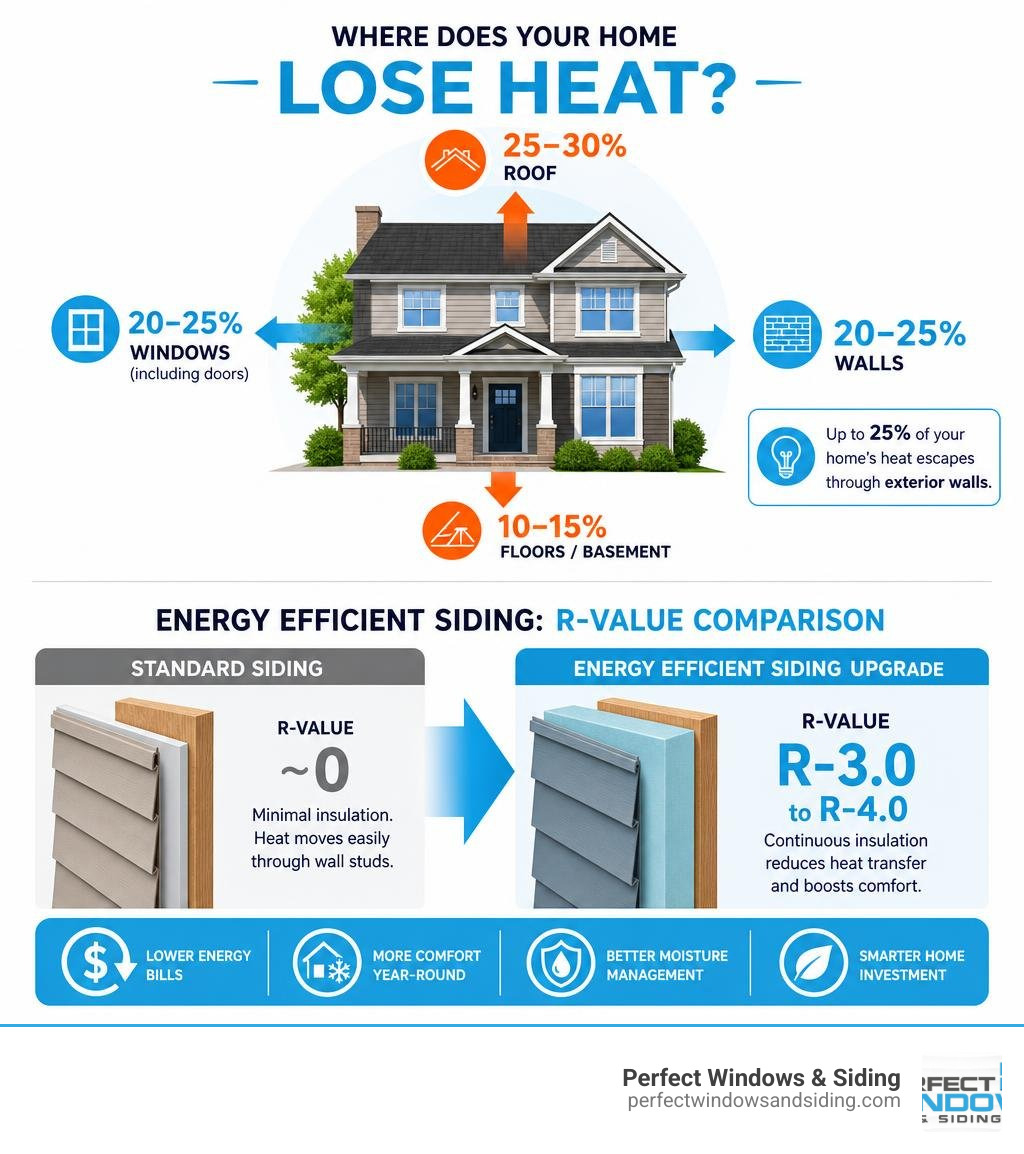
- Adds R-3.0 to R-4.0 of continuous insulation across your entire wall surface
- Eliminates thermal bridging through wall studs
- Improves moisture management and reduces drafts
- Qualifies for a 30% federal tax credit on materials under the Inflation Reduction Act (through 2032)
- Increases home resale value, with homeowners recouping 60–75% of costs at resale
Here’s the problem most Chicago homeowners don’t think about: your walls are working against you.
About 20–25% of your home’s heat escapes through exterior walls. Old or standard siding does almost nothing to stop it. It has an R-value close to zero — meaning heat pours out in winter and floods in during summer. Your furnace and AC work harder. Your energy bills climb higher.
And most people replace siding without fixing this. In fact, research from Pacific Northwest National Laboratory found that less than 10% of re-siding projects add even one inch of insulation — leaving a massive energy-saving opportunity on the table.
That’s exactly the opportunity this guide is designed to help you capture.
I’m Voytek Glab, owner of Perfect Windows & Siding, and over my 20+ years working on exterior remodeling across the Chicagoland area I’ve helped countless homeowners transform their homes with a proper energy efficient siding upgrade — not just a cosmetic refresh, but a real performance improvement. I’ll walk you through everything you need to know to make the right decision for your home.
What is an Energy Efficient Siding Upgrade?
To understand what makes a siding upgrade energy-efficient, we have to look at what lies directly beneath the surface of your home’s exterior. Standard siding is essentially a thin protective skin. While it shields your home from wind and rain, it offers virtually no thermal resistance.
An energy efficient siding upgrade represents a complete engineered wall system designed to maximize your home’s thermal envelope. This upgrade typically combines high-performance siding materials with integrated or continuous underlayment insulation. By wrapping your home in a protective, insulated blanket, you are addressing the three primary drivers of energy waste: thermal bridging, air infiltration, and moisture accumulation.
When you invest in this upgrade, you are not just changing the color of your home; you are fundamentally altering how your home handles heat. The primary metric used to measure this performance is “R-value,” which quantifies a material’s resistance to heat flow. The higher the R-value, the better the material is at keeping warm air inside during our freezing winters and keeping it outside during humid summers.
Beyond lowering your utility bills, there are numerous benefits of upgrading your home’s exterior that touch on structural longevity, interior comfort, and long-term property protection.
Choosing the Right Energy Efficient Siding Upgrade for Chicago Climates
Our weather in the Chicagoland area is notoriously demanding. From sub-zero winter winds blowing off Lake Michigan to scorching, humid July afternoons, our homes undergo severe temperature swings. This constant expansion and contraction put immense stress on standard building materials.
In places like Naperville, Schaumburg, and Des Plaines, older homes often rely solely on cavity insulation (the insulation placed between the wood studs inside your walls). However, wood studs themselves conduct heat. In the dead of winter, those studs act as thermal highways, letting cold air bypass your interior insulation entirely.
An energy efficient siding upgrade tailored for our local climate introduces a continuous thermal barrier that stops this heat transfer in its tracks. When exploring siding replacement options in Chicago, it is crucial to select materials that can withstand these extreme freeze-thaw cycles without cracking, warping, or losing their insulating properties.
Financial Incentives for Your Energy Efficient Siding Upgrade in 2026
As of June 2026, homeowners have access to substantial federal incentives that make upgrading your home’s exterior performance highly advantageous. Under the Inflation Reduction Act, homeowners who choose qualifying energy-efficient materials—including insulated siding systems—are eligible for a federal tax credit of up to 30% of the cost of the qualifying insulation materials.
To secure these savings, it is important to work with a knowledgeable contractor who can provide the necessary manufacturer certifications and detailed invoices specifying the material components of your project. By combining these federal tax credits with the compounding annual energy savings on your heating and cooling bills, the long-term return on investment becomes exceptionally strong. For detailed verification of the current standards, you can review the 2026 federal tax credit guidelines to see how these incentives apply directly to your upcoming renovation.
High-Performance Materials for Your Home
Selecting the right material is the foundation of a successful siding project. Modern manufacturing has evolved significantly, offering options that balance traditional beauty with advanced thermal science. Whether you prefer the classic look of wood or the low-maintenance durability of engineered composites, there is a high-performance solution available.
To help you visualize how these options compare, we have compiled a breakdown of the most common high-performance materials used in the Chicagoland area:
| Siding Material Type | Average R-Value | Durability Rating | Maintenance Required | Best Climate Fit |
|---|---|---|---|---|
| Standard Vinyl | 0.6 | Moderate | Very Low | Moderate Climates |
| Insulated Vinyl | 2.0 – 4.0 | High | Very Low | Extreme Cold & Heat |
| Fiber Cement (with Foam) | 2.5 – 5.0+ | Excellent | Low | All Climates |
| Engineered Wood | 1.5 – 2.5 | High | Low to Moderate | Cold & Mixed Climates |
For a comprehensive look at how these materials fit into your overall home renovation plan, explore our detailed guide to exterior siding solutions.
Insulated Vinyl Siding
Insulated vinyl siding is one of the most popular choices for Midwestern homeowners seeking superior thermal performance. Unlike standard vinyl, which is hollow and flexible, insulated vinyl features rigid foam backing permanently bonded to the exterior panel. This backing is typically composed of expanded polystyrene (EPS), which fills the void behind the siding profile.
A prime example of this technology is Prodigy next-generation insulated siding, which features a 1.5-inch thick insulated core. This represents some of the thickest one-piece insulation available on the market today. This integrated foam backing does more than just stop heat; it creates a structurally rigid panel that resists impact from hail, stray baseballs, and high winds.
Furthermore, the interlocking panel design ensures a tight seam connection, virtually eliminating the gaps where air leaks typically occur. To learn more about how this material holds up against local weather, read about the benefits of vinyl siding for Illinois homes.
Fiber Cement and Engineered Wood
If you love the authentic look of painted wood but demand top-tier durability, fiber cement and engineered wood are outstanding choices. Fiber cement is crafted from a precise blend of cement, sand, and cellulose fibers. This composition makes it completely impervious to rot, wood-boring insects, and fire.
When paired with a high-density rigid foam underlayment during a fiber cement siding installation, this material delivers exceptional R-value performance while providing an incredibly solid, premium feel.
Engineered wood siding offers a similar aesthetic benefit, utilizing treated wood fibers combined with water-resistant resins to create highly durable, deeply textured planks. Both options provide incredible design versatility, allowing you to achieve gorgeous curb appeal without sacrificing energy efficiency. To see how these materials stack up side-by-side, check out our comparison of different siding types.
The Power of Continuous Exterior Insulation
To truly understand why an energy efficient siding upgrade is so effective, we must look at how insulation is traditionally installed. Most homes built before 1992 suffer from inadequate air sealing and insulation. Even in newer homes, insulation is typically placed only between the wall studs.
Continuous exterior insulation changes the game. By applying a continuous layer of rigid foam insulation directly over your home’s sheathing before the new siding is hung, you create an unbroken thermal barrier around your entire living space.

This method acts like a high-tech windbreaker for your house, stopping drafts and sealing small cracks that allow air to escape. This approach is backed by extensive building science, including the PNNL research on re-siding and exterior insulation, which demonstrates that adding continuous insulation during a re-siding project is one of the most cost-effective ways to upgrade an older home’s energy performance.
Eliminating Thermal Bridging
Let’s talk science for a moment. In a standard home, wood studs make up roughly 25% of the total wall surface area. Because wood is a poor insulator compared to fiberglass or foam, heat flows easily through these studs. This physical phenomenon is known as “thermal bridging.”
Imagine wearing a warm winter coat but leaving it completely unzipped in the front. The fabric keeps your arms warm, but the open middle lets all your body heat escape. That is exactly what your home does when it lacks continuous exterior insulation.
By installing an R-5 continuous insulation layer directly beneath your new siding, you cover those wooden studs. This simple measure can prevent more than 25% of the energy waste associated with uninsulated wall framing. For a real-world look at how this works in practice, you can read the DOE case study on siding retrofits, which details the dramatic comfort and efficiency improvements achieved through advanced exterior retrofits.
Professional Installation and Long-Term Protection
Even the most advanced siding material will fail to deliver its promised energy savings if it is installed incorrectly. Proper installation requires meticulous attention to detail, especially when it comes to integrating the water-resistive barrier (WRB), window flashing, and siding locks.
At Perfect Windows & Siding, we understand that your home’s exterior must function as a cohesive system. Gaps in the insulation, poorly taped seams, or improper flashing can trap moisture behind your walls, leading to mold growth and structural rot.
Our experienced, factory-certified installation teams ensure that every layer of your new siding system is installed to the highest industry standards. This level of craftsmanship is why we confidently back our work with a lifetime warranty, giving you peace of mind that your investment is fully protected. To learn more about our process, explore our expert siding installation services.
Frequently Asked Questions about Siding Upgrades
How do I know if my home needs new siding?
There are several clear warning signs that your current siding is no longer protecting your home:
- Warping or Rotting: If your wood or vinyl planks are warping, bending, or rotting, moisture has likely penetrated the outer barrier.
- Drafts Near Walls: If you feel cold drafts near your exterior walls or electrical outlets, your home’s thermal envelope has compromised areas.
- Unexplained Energy Spikes: If your heating and cooling bills are steadily climbing despite regular HVAC maintenance, your walls are likely losing heat.
- Peeling Interior Paint or Wallpaper: When moisture gets trapped beneath siding, it can seep through the drywall, causing interior paint to bubble or wallpaper to peel.
Can new siding reduce outdoor noise?
Yes! One of the most immediate, pleasant surprises for homeowners who choose insulated siding is how quiet their home becomes. The dense layer of expanded polystyrene (EPS) foam backing acts as an excellent acoustic barrier. It adds significant acoustic mass to your walls, noticeably dampening sounds from traffic, lawnmowers, barking dogs, and overhead airplanes. If you live near a busy road in Morton Grove or Park Ridge, this acoustic benefit can dramatically improve your daily quality of life.
What is the best time of year to replace siding?
Siding replacement can actually be performed year-round. Because siding installation does not involve “wet works” like masonry or concrete, professional crews can install it in winter just as effectively as in summer. However, spring and autumn are highly popular because the moderate temperatures make the installation process comfortable for both the home and the crew. Planning your project ahead of these peak seasons ensures you get on the schedule at the perfect time.
Conclusion
An energy efficient siding upgrade is far more than a simple home improvement project; it is a long-term investment in your home’s comfort, structural integrity, and financial efficiency. By wrapping your home in high-performance materials and continuous insulation, you protect your household from Chicago’s harsh elements while enjoying lower utility bills for decades to come.
At Perfect Windows & Siding, we bring over 20 years of local, family-owned expertise to every project. We serve homeowners across the entire Chicagoland area, including Des Plaines, Park Ridge, Glenview, and Morton Grove. We are dedicated to providing custom exterior solutions, exceptional craftsmanship, and a lifetime warranty that ensures your home remains beautiful and efficient.

Ready to take the next step toward a more comfortable, energy-efficient home? Schedule your consultation with our expert team today to get a free estimate and discover how we can transform your home’s exterior.