

Fiber Cement Siding Installation in Chicago
Perfect Windows & Siding
Let’s Work Together!
Perfect Windows & Siding
Let’s Work Together!
We install fiber cement siding in Chicago and surrounding suburbs. Before selecting the finish, discuss the condition of the existing exterior, the profiles you prefer and the work needed around windows, doors and trim. Product-specific installation and maintenance requirements should form part of the comparison.
Use our siding service overview to compare the scope of work, or review vinyl siding installation if you are considering both materials. Our siding replacement service is relevant when existing cladding needs to be removed and renewed. Ask about wall preparation, moisture management, clearances and the finishing included in your estimate.
Browse our project gallery and request a free estimate. Photographs of the exterior and the areas you want to change help explain your enquiry. Check our service areas for local service information, and discuss the proposed materials and warranty terms for your particular project.
Fiber cement siding is a composite exterior cladding material manufactured from a mixture of Portland cement, sand, and cellulose fiber. The combination produces a panel that is dimensionally stable, non-combustible, resistant to moisture and pests, and capable of replicating the appearance of wood lap siding, wood shingles, or smooth board at a level of detail that vinyl cannot match. It is heavier than vinyl, more demanding to install, and requires painting — but it outperforms vinyl on durability, appearance quality, fire resistance, and long-term service life by margins that are meaningful for Chicago homeowners making a 30-plus-year exterior investment.
In Chicago, fiber cement siding is gaining ground in the residential market for reasons that are specific to this climate and this housing stock. The city’s freeze-thaw cycling, summer humidity, and sustained cold impose performance demands on exterior cladding that separate adequate materials from excellent ones over a 30-year service life. Fiber cement meets those demands at a higher threshold than vinyl. It also addresses a concern that vinyl does not — fire resistance in a city where frame construction homes sit close together across established neighborhoods from Logan Square to Norwood Park.
This page covers fiber cement siding installation in Chicago in full — what the material is and how it performs, its specific benefits for Chicago homes, how it compares to vinyl, how long it lasts in this climate, what painting requires in practice, and how long installation takes. It is written for homeowners who are evaluating fiber cement seriously and need accurate, specific information before they commit to a specification.
We install fiber cement siding throughout Chicago and the surrounding suburbs. Free estimates are available — call us to schedule yours.
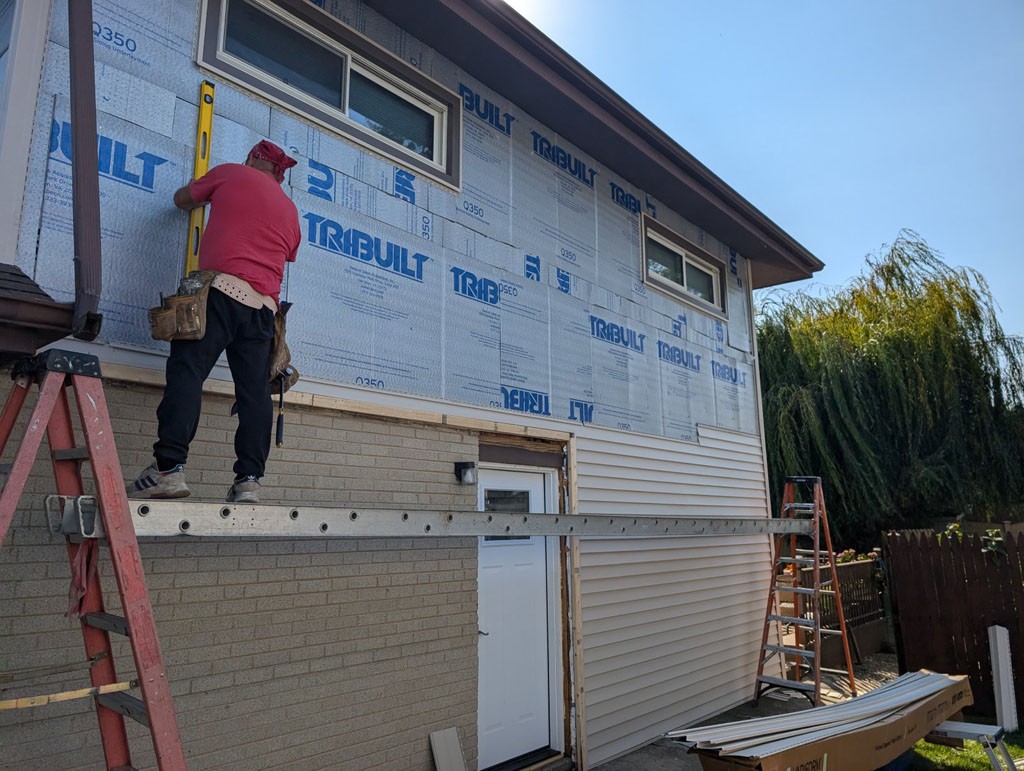
Fiber cement siding is manufactured by combining Portland cement, ground sand, and cellulose fiber — wood pulp processed to remove the organic components that would otherwise be susceptible to moisture degradation — under pressure and heat into panels, planks, and trim profiles. The result is a material that has the workability of wood — it can be cut with standard tools, nailed, and shaped — with the weather resistance of cement and the dimensional stability that neither wood nor vinyl can match across Chicago’s temperature range.
The material is manufactured in profiles that replicate the appearance of traditional wood siding — horizontal lap planks with shadow lines and wood grain texture, vertical board and batten, smooth panel, and cedar shingle patterns. The replication is more convincing than vinyl’s equivalent profiles because fiber cement’s texture depth and surface density accept paint differently than vinyl’s smooth extruded surface. A painted fiber cement lap plank reads as wood siding from street distance and close inspection in a way that vinyl’s molded texture does not.
Dimensional stability in Chicago’s climate Fiber cement’s dimensional stability is one of its most consequential performance characteristics for Chicago installations. The coefficient of thermal expansion for fiber cement is significantly lower than vinyl’s — fiber cement expands and contracts less across the temperature range Chicago produces than vinyl does. A vinyl panel cycling between a July afternoon at 95°F and a January night at -10°F moves substantially. Fiber cement covering the same range moves far less.
That stability matters for installation longevity. The thermal expansion cycling that requires vinyl installations to be executed with precise nail slot spacing — and that causes vinyl to buckle when that spacing is incorrect — is a less critical variable with fiber cement. The panels are fastened directly rather than hung in slots, and the reduced expansion magnitude means that fastener and joint behavior over 30 years of temperature cycling is more predictable and less stress-intensive than vinyl’s equivalent behavior.
Fire resistance Fiber cement is non-combustible. It does not ignite, does not contribute to flame spread, and does not melt or deform under fire conditions. This characteristic is recognized by Chicago’s building code and by residential insurance underwriters as a meaningful fire resistance property for exterior cladding.
In Chicago’s densely built residential neighborhoods — the vintage frame construction of Logan Square, Ukrainian Village, and Pilsen where homes sit on narrow lots with limited setbacks — the fire resistance of exterior cladding has practical consequences. Vinyl siding melts and deforms in fire conditions and can contribute to flame spread between closely spaced structures. Fiber cement does neither. For homeowners in Chicago’s established urban neighborhoods making a long-term siding investment, the fire resistance differential between fiber cement and vinyl is a legitimate specification consideration, not a marketing claim.
Impact resistance Fiber cement is substantially harder than vinyl. Hail impact, wind-driven debris, and incidental mechanical contact that dents or cracks vinyl panels do not produce equivalent damage on fiber cement. Chicago’s spring and summer hail events are frequent enough that impact resistance is a relevant performance variable for exterior cladding — the Northwest Side, Park Ridge, and Glenview all sit in hail corridors that produce measurable hail damage to vinyl siding across multiple seasons per decade.
Fiber cement’s impact resistance also means it does not deform under sustained heat exposure in the way that vinyl can. Vinyl panels in direct summer sun on south- and west-facing elevations in Chicago can reach surface temperatures that cause visible distortion in thinner panel products. Fiber cement does not have a deformation threshold within the temperature range Chicago produces.
Rot and pest resistance The cement-based composition of fiber cement provides no nutritional value to wood-boring insects and does not absorb moisture in the way that wood does. Termite and carpenter ant damage — a documented issue in Chicago’s older wood-framed housing stock, particularly in neighborhoods with mature tree canopy and soil moisture — does not affect fiber cement. The material cannot be colonized, cannot be consumed, and does not provide the moisture retention that wood-boring insects require.
Rot resistance follows the same logic. Fiber cement does not contain the organic material that biological decay organisms require. Moisture that contacts the fiber cement surface does not initiate the rot cycle that moisture contact with wood initiates. This is a meaningful performance difference for Chicago installations where moisture management is a continuous challenge across a six-month period of freeze-thaw cycling.
Paint retention Fiber cement holds paint significantly longer than wood. The material’s low porosity and dimensional stability — it does not expand and contract with moisture absorption the way wood does — mean that the paint film applied to its surface is not subjected to the substrate movement that drives paint failure on wood siding.
Wood siding in Chicago’s climate requires repainting every five to seven years to maintain weather resistance and appearance. The same conditions — UV exposure, moisture cycling, freeze-thaw stress — produce paint degradation on fiber cement at a substantially slower rate. Factory-applied finish products carry specified recoat intervals of 15 years or more. Field-applied paint on fiber cement in Chicago’s climate consistently outperforms the same paint on wood by a significant margin.
For homeowners in Winnetka, Evanston, and Park Ridge investing in fiber cement on homes they intend to hold for 25 or more years, the paint maintenance differential between fiber cement and wood is a real long-term cost consideration — not an abstract specification advantage.
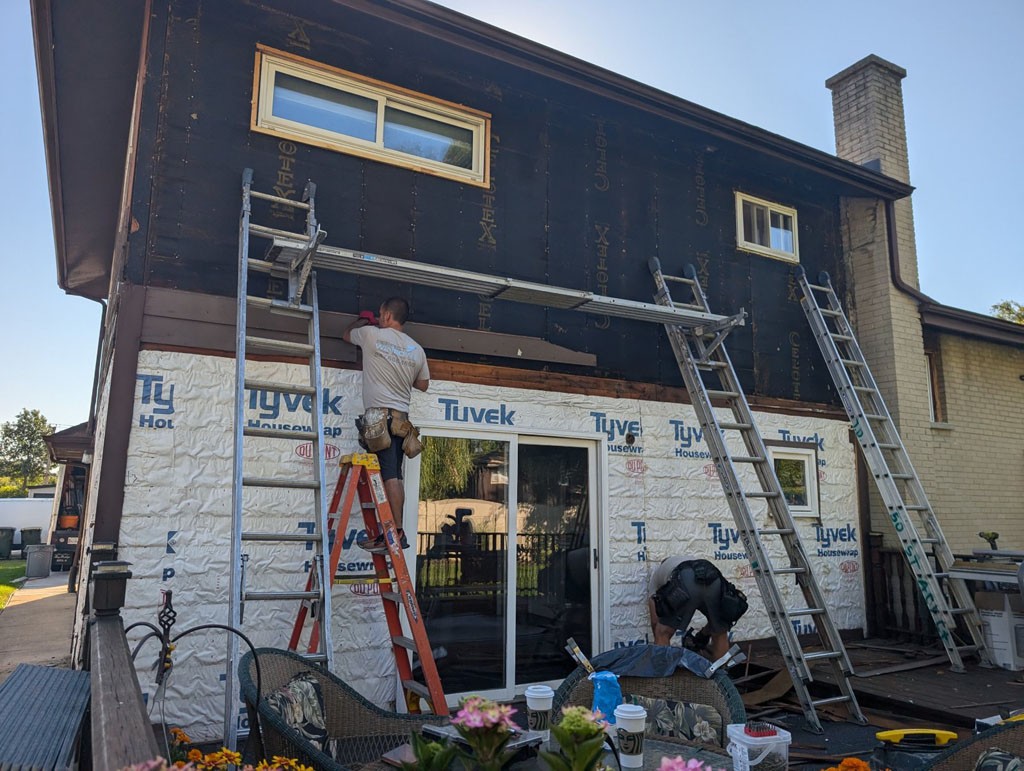
The comparison between fiber cement and vinyl is the most common specification decision conversation in Chicago’s residential exterior market. Both are appropriate materials for this climate. The correct choice depends on the homeowner’s priorities — and the priorities that favor fiber cement are different from the priorities that favor vinyl.
Where fiber cement is superior
Appearance quality. Fiber cement produces a more convincing wood replication than vinyl at every scale of observation — from street distance, from the property line, and in close inspection. The texture depth of fiber cement’s wood grain profiles, combined with the way paint sits and ages on a cement-based substrate, reads as traditional painted wood siding in a way that vinyl’s molded surface does not. For homeowners in Lincoln Square, Norwood Park, and Jefferson Park where architectural consistency within the neighborhood matters — where a home’s exterior is expected to be compatible with adjacent 1920s and 30s construction — fiber cement’s appearance quality is a meaningful differentiator.
Impact resistance. Fiber cement does not dent from hail and does not crack from incidental impact. Vinyl’s impact resistance is adequate under normal conditions but fails under hail events significant enough to be common in Chicago’s climate.
Fire resistance. Fiber cement is non-combustible. Vinyl is not. In Chicago’s densely built residential neighborhoods, that distinction has practical significance.
Service life. Correctly maintained fiber cement has a service life of 30 to 50 years. Vinyl’s service life is 20 to 40 years. Both ranges are wide and dependent on installation quality and maintenance — but fiber cement’s upper range exceeds vinyl’s by a meaningful margin for homeowners making a maximum-duration investment decision.
Where vinyl is superior
Installation simplicity. Vinyl installs faster than fiber cement, requires no painting step, and is lighter and easier to handle. Installation complexity and labor time are both lower for vinyl than for fiber cement of equivalent wall area.
Maintenance. Vinyl requires no painting. Fiber cement requires repainting on a schedule — 15 years or more for factory-finished products, shorter intervals for field-painted products depending on paint quality and application conditions. The no-paint maintenance of vinyl is a real advantage for homeowners who want the lowest possible ongoing exterior maintenance commitment.
Cold-weather installation flexibility. Vinyl can be installed in a wider range of temperature conditions than fiber cement with a field painting step. Paint application constraints — minimum temperature, maximum humidity, rain-free window — narrow fiber cement’s installation season in Chicago’s shoulder months in a way that vinyl’s installation does not encounter.
The specification decision The homeowner who should specify fiber cement over vinyl in Chicago is one who prioritizes appearance quality, long-term durability, fire resistance in a dense neighborhood, and is prepared to accept a painting maintenance requirement in exchange for those benefits. The homeowner who should specify vinyl is one who prioritizes no-paint maintenance, faster installation, and adequate performance in Chicago’s climate without the premium performance ceiling that fiber cement offers.
Both are correct choices for different priorities. Neither is universally superior. The on-site estimate conversation covers the specific conditions of each home and helps homeowners identify which set of priorities applies to their situation.
Fiber cement siding correctly installed and maintained has a service life of 30 to 50 years in Chicago’s climate. That range is the widest of any common residential siding material, and it reflects the material’s fundamental resistance to the degradation mechanisms that limit other materials’ service lives.
What does not degrade fiber cement Moisture does not degrade fiber cement’s structural integrity. The material absorbs minimal moisture at its surface and does not allow moisture penetration into its composition in the way that wood does. Freeze-thaw cycling — the primary mechanical stress on exterior materials in Chicago’s climate — does not produce the expansion and contraction in fiber cement’s absorbed moisture that it produces in wood, and does not cause the cracking and delamination that freeze-thaw cycling causes in less stable materials.
UV exposure does not degrade fiber cement’s substrate. The cement composition is not affected by UV radiation in the way that vinyl’s polymers are — vinyl eventually becomes brittle and chalky from sustained UV exposure regardless of color; fiber cement’s substrate remains structurally intact under equivalent UV exposure. UV exposure affects the paint on fiber cement, not the material itself — and paint is maintainable on a schedule.
Insects do not degrade fiber cement. Termites, carpenter ants, and wood-boring beetles that damage Chicago’s older wood-framed homes have no mechanism for attacking fiber cement’s cement-based composition.
What does affect fiber cement’s service life Paint maintenance is the primary variable that determines where a fiber cement installation falls within the 30-to-50-year service life range. Fiber cement that is allowed to reach a condition where the paint film is fully degraded and bare substrate is exposed to direct moisture contact will eventually show surface erosion at those exposure points. The substrate does not fail quickly under those conditions — fiber cement is not as moisture-sensitive as wood — but sustained bare substrate exposure in Chicago’s climate will produce gradual surface erosion over time.
The practical maintenance requirement is straightforward: inspect the exterior paint condition every five years and repaint any areas showing paint failure before bare substrate exposure occurs. A factory-finished fiber cement installation in Chicago should reach its first full repainting cycle at 15 years or more with normal inspection and spot-touch maintenance. Field-painted installations should be inspected on a similar schedule with repainting triggered by visible paint degradation rather than a fixed interval.
Homeowners in Winnetka and Evanston investing in fiber cement on high-value properties should understand that the 50-year upper end of the service life range assumes consistent paint maintenance was performed throughout. A fiber cement installation that reaches 20 years with no repainting will be in worse condition than one that received a 15-year repaint — but the substrate will still be structurally intact, and repainting at that point restores full performance going forward.
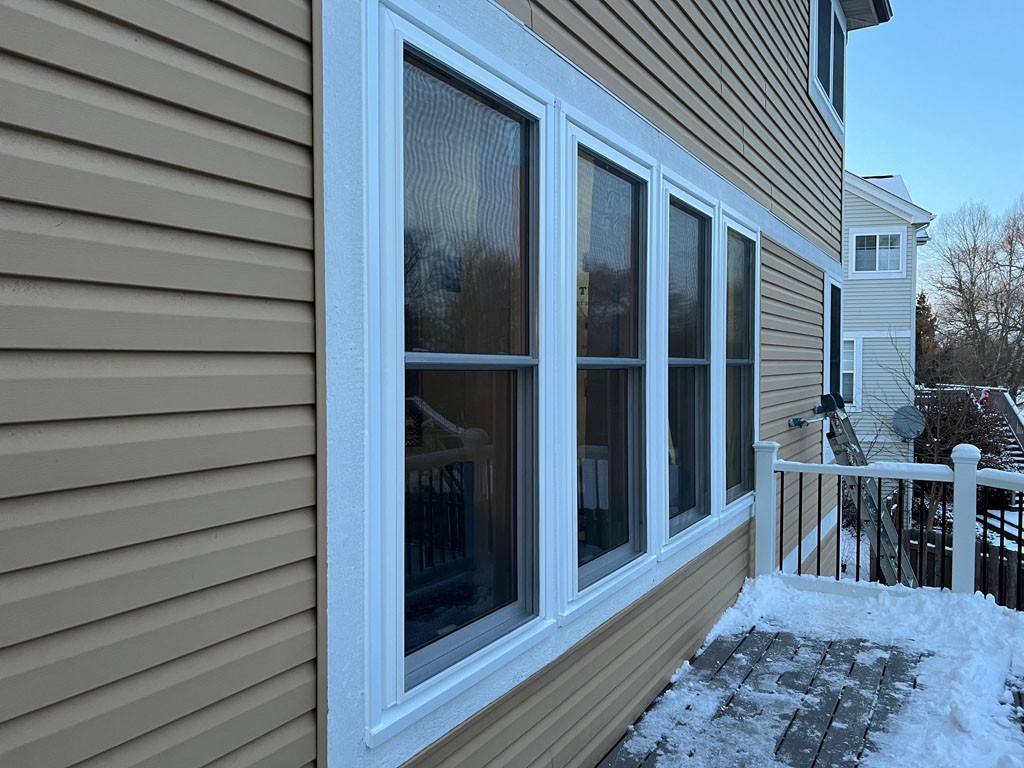
Fiber cement must be painted. This is the most important maintenance fact about the material and the most common source of homeowner misunderstanding when comparing fiber cement to vinyl. Vinyl requires no painting — ever. Fiber cement requires painting at installation and repainting on a schedule. That requirement is real, it has practical implications for installation timeline and ongoing maintenance, and it should be understood clearly before a fiber cement specification is finalized.
Factory-finished vs. field-painted fiber cement The two approaches to fiber cement painting produce different outcomes and impose different requirements on the installation process.
Factory-finished fiber cement arrives at the job site with a manufacturer-applied color coating applied under controlled temperature, humidity, and cure conditions at the manufacturing facility. The coating quality achievable under factory conditions is higher than what field painting can consistently produce — controlled cure temperatures, consistent film thickness, and quality assurance inspection before the product ships. Factory-finished products carry manufacturer-specified recoat intervals that reflect the performance of the factory coating system — typically 15 years or more depending on the product line and color.
Factory-finished fiber cement simplifies the installation process. The color coat is already applied when the panels arrive. The installation crew handles painted panels, cuts are sealed at the factory-specified method, and field touch-up of cut edges is performed with a compatible paint. No full color coat application step is required on-site.
Field-painted fiber cement arrives factory-primed — a primer coat applied at the factory that prepares the surface for field painting and provides temporary weather resistance during shipping and installation. The color coat is applied on-site after installation is complete. Field painting gives the homeowner complete color selection flexibility and allows color changes without requiring new product. It also means the installation is not complete until the painting step is finished — the primed panels are installed, and then the painting crew applies the color coat.
Paint application conditions in Chicago Paint application on fiber cement requires specific temperature and humidity conditions that are not always available in Chicago’s climate, particularly during shoulder seasons.
Exterior latex paint — the appropriate product for fiber cement field painting — should not be applied when air or surface temperature is below 50°F or above 90°F. It should not be applied when rain is forecast within the application window specified by the paint manufacturer — typically 24 to 48 hours. It should not be applied when relative humidity exceeds the paint manufacturer’s specified maximum — typically 85%.
In Chicago, these conditions narrow the practical field painting window to late April through mid-October with weather-dependent scheduling within that period. Late October installations that include field painting are subject to schedule risk from early cold snaps. November through March installations involving field painting are effectively impossible without temperature-controlled enclosures that are not practical for residential exterior work.
The scheduling implication for Chicago homeowners is direct: fiber cement installations that include field painting should be scheduled with adequate lead time to complete the painting step before October temperatures become unreliable. Projects initiated in September should be assessed for painting schedule feasibility before the installation scope is confirmed.
For homeowners in Des Plaines and the northwest suburbs who are planning fiber cement installations in the fall, we address this directly during the estimate — confirming whether the project timeline allows for field painting completion before Chicago’s shoulder season closes the painting window, and whether factory-finished product is a more practical specification for the available schedule.
Fiber cement siding installation takes longer than vinyl installation for the same wall area. The material is heavier, requires two-person handling for most panel sizes, uses different cutting tools and techniques, and involves a painting step — either factory-finish touch-up and cut edge sealing, or full field color coat application — that vinyl installation does not require. These are not inefficiencies — they are characteristics of the material and its installation requirements.
The installation sequence Fiber cement installation follows a defined sequence that is similar to vinyl installation in structure but different in execution at nearly every step.
Timeline A standard single-family Chicago home — 1,200 to 1,800 square feet of exterior wall area — takes four to seven days for fiber cement installation including field painting. Larger homes, homes with complex architectural features, or projects requiring substrate repair take longer. Factory-finished installations without a field painting step are faster — typically three to five days for the same wall area — because the painting step and its associated dry time are eliminated from the on-site schedule.
We provide a specific timeline during the free estimate based on the home’s actual wall area, condition, and specification. For projects that include field painting, we confirm weather forecast conditions before scheduling the painting step and adjust the sequence if conditions are not suitable for paint application.
Fiber cement is a composite of Portland cement, sand, and cellulose fiber manufactured into siding panels, planks, and trim. It is appropriate for Chicago homes where long-term durability, fire resistance, impact resistance, and a convincing wood appearance are priorities. It requires painting and takes longer to install than vinyl — whether those trade-offs are correct for a specific home depends on the homeowner’s priorities, and an on-site estimate addresses that question directly.
Fiber cement is harder, more impact-resistant, fire-resistant, more convincingly wood-like in appearance, and has a longer service life than vinyl. Vinyl requires no painting, installs faster, and has lower installation complexity. The correct choice depends on priorities — appearance quality, durability, and fire resistance favor fiber cement; no-paint maintenance and simpler installation favor vinyl. Both are appropriate for Chicago’s climate.
30 to 50 years with correct installation and paint maintenance. The material does not degrade from moisture, freeze-thaw cycling, UV exposure, or insects — service life is determined primarily by paint maintenance, not substrate degradation. Fiber cement that is repainted on schedule retains its structural integrity and weather resistance for the full service life range.
Yes — fiber cement must be painted, either with a factory-applied color coat or with field-applied primer and color coat at installation. Factory-finished products carry recoat intervals of 15 years or more. Field-painted installations should be inspected every five years and repainted when paint degradation is visible. Paint application in Chicago requires specific temperature and humidity conditions that narrow the painting window to late April through mid-October.
Four to seven days for a standard single-family home with field painting. Factory-finished installations are faster — three to five days for the same wall area. Larger homes, complex architectural features, or substrate repair requirements extend the timeline. We provide a specific timeline during the free estimate. Field painting scheduling is confirmed against weather forecast conditions before the painting step is scheduled.
Yes. We serve Chicago and the full Chicagoland area — including Des Plaines, Park Ridge, Morton Grove, Niles, Glenview, Winnetka, Naperville, Evanston, Hoffman Estates, and surrounding communities. Call us to schedule a free on-site estimate at your home.
Fiber cement siding installation in Chicago requires an on-site assessment before scope, substrate condition, painting approach, and installation timeline can be determined accurately. Wall area, existing siding condition, moisture barrier status, and scheduling constraints relative to Chicago’s painting season all affect the correct installation plan — and none of those variables are assessable without a site visit.
📞 Call us today to schedule a free consultation today!
2026 Perfect Windows & Siding Powered by Wizerunek w Sieci - web development & SEO | Privacy | Accessibility | Terms and Conditions
This site is protected by reCAPTCHA and the Google Privacy Policy and Terms of Service apply.