

Why LP Soffit Installation Matters for Your Home’s Protection
LP soffit installation is a critical step in protecting your home’s eaves while improving both ventilation and curb appeal. When you install LP SmartSide soffit correctly, you’re not just adding an attractive finish to your roof line – you’re creating a barrier that helps prevent moisture damage and provides essential attic ventilation.
Quick LP Soffit Installation Overview:
- Choose your soffit type – Panel or cut-to-width, vented or non-vented
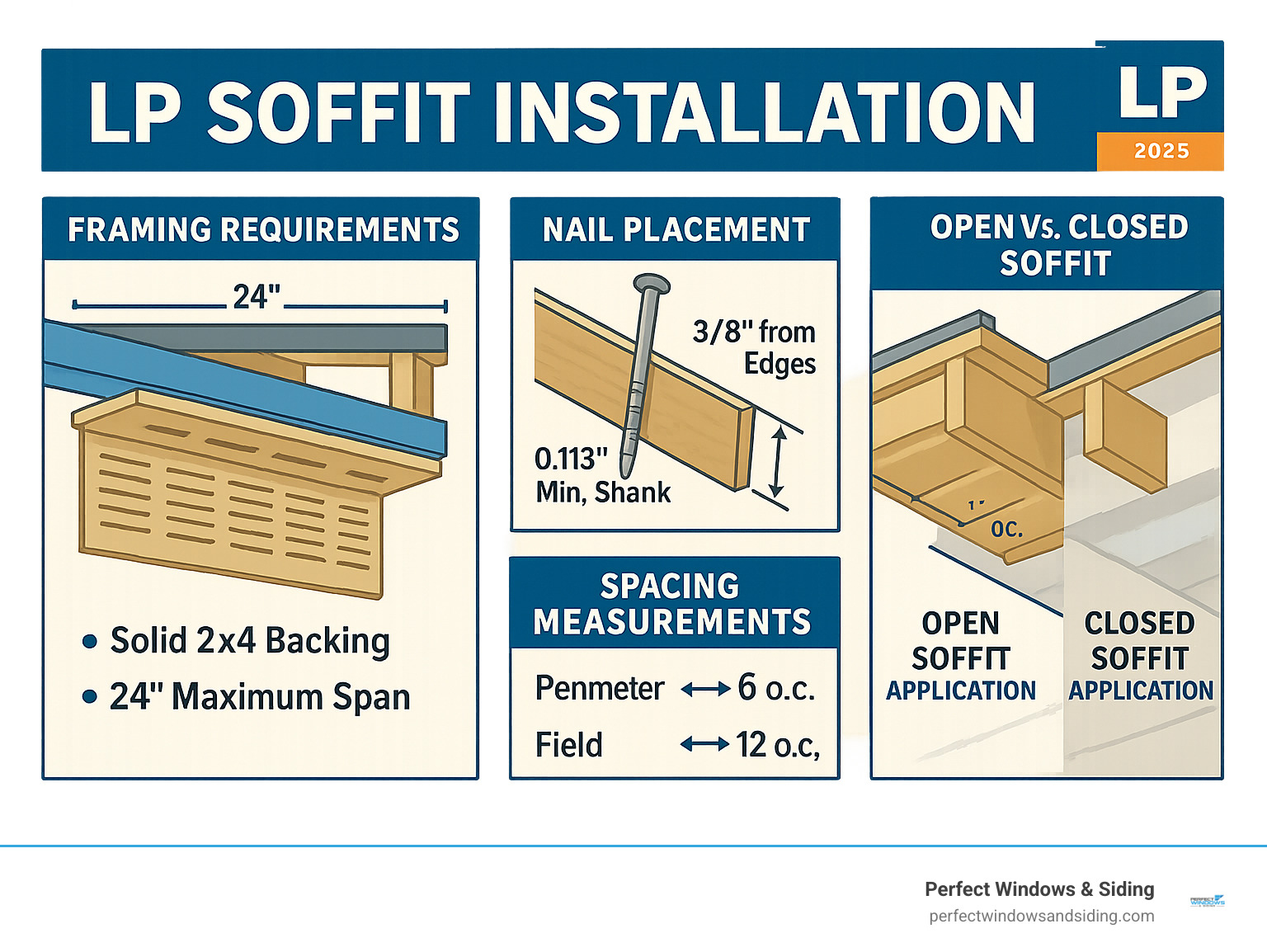
- Prepare the framing – Ensure 24-inch maximum span with solid 2×4 backing
- Use proper fasteners – Hot-dipped galvanized nails, 0.113″ minimum shank
- Follow spacing rules – 3/8″ from edges, 6″ on center at perimeters
- Seal and paint – Prime all cut edges and apply 100% acrylic latex paint
LP SmartSide soffit offers significant advantages over traditional materials. The engineered wood construction resists impacts, freeze-thaw cycles, and fungal decay thanks to the proprietary SmartGuard process. Vented soffit panels provide 10 square inches of ventilation per linear foot, helping prevent mold and mildew while reducing energy costs.
The key to successful installation lies in proper preparation and following manufacturer guidelines. All panel ends and edges must be supported by solid framing, and specific nail spacing requirements ensure your soffit will withstand wind loads up to 200 mph when installed correctly.
I’m Voytek Glab, owner of Perfect Windows & Siding, and I’ve been helping Chicago-area homeowners with exterior remodeling for over 20 years. My team and I have completed countless LP soffit installation projects, and I’ll share the exact techniques we use to ensure a professional, warranty-compliant finish every time.
Important lp soffit installation terms:
Preparing for a Flawless Installation
Alright, before we even think about picking up a nail gun, let’s talk about getting ready. Proper preparation is truly the secret sauce for a successful LP soffit installation. Think of it like baking a delicious cake – you need all your ingredients measured and ready, and your oven preheated, right? It’s the same idea when it comes to your home’s soffit.
First off, did you know there are different types of LP SmartSide soffit? You can choose between panel soffit and cut-to-width soffit. Both options come in vented and non-vented styles. Your choice often depends on the exact size of your eaves and whether you prefer working with larger sheets or pre-cut boards. Vented soffit is super important for good attic airflow, while non-vented is used where that airflow isn’t needed or comes from somewhere else.
Now, let’s talk about what’s behind the soffit: your home’s framing. LP SmartSide soffit is designed to be very flexible. It can go over framing that’s spaced up to 24 inches on center. This means your rafters or eave blocking shouldn’t be more than 24 inches apart. Here’s a crucial point: every single panel end and edge must be supported by solid 2×4-inch or larger framing. If your current setup doesn’t quite meet this, you’ll need to add some blocking. This solid support is key for your soffit to last a long, long time.

What Tools and Materials Do You Need?
Having the right tools on hand makes a huge difference. Our team at Perfect Windows & Siding always makes sure we’ve got everything needed to make the LP soffit installation go smoothly and efficiently. Here’s a rundown of the essential tools and materials you’ll want:
First up, for cutting, you’ll definitely need a good Circular saw. It’s crucial for getting those clean, precise cuts. If you’re working with bigger panels, a track saw can also be super helpful for perfectly straight lines.
For marking everything out, a Chalk line is your best friend for long, straight marks and keeping panels perfectly aligned. Don’t forget a reliable measuring tape and a speed square – they’re absolute must-haves!
When it comes to fastening, a good nail gun will make the job much faster. Just be sure it’s set correctly so you don’t overdrive the nails. And speaking of nails, you’ll need hot-dipped galvanized nails. These are important because they resist rust. Look for ones with at least a .113-inch shank diameter and a .270-inch head. They need to be long enough to go into your framing by at least one and a half inches. For example, 6d or 8d nails are often just right.
For sealing things up, grab a Caulking gun. You’ll use it to apply sealant at joints and around any openings.
And for the finishing touches, you’ll need high-quality 100% acrylic latex paint (or a semi-gloss/satin oil/alkyd paint) and primer. These are vital for sealing any cut edges and giving your new soffit a beautiful, lasting finish.
Most importantly, don’t forget your safety gear! Always wear safety glasses, work gloves, and a dust mask. Cutting engineered wood can create dust, and we want to keep you safe.
Lastly, have your basic carpentry hand tools ready. A hammer, utility knife, level, and a pry bar always come in handy during any project like this.
Key Preparation Steps for LP Soffit Installation
Preparation isn’t just about collecting your tools; it’s also about getting your job site and the materials themselves ready. These steps are super important for a durable and warranty-compliant LP soffit installation:
- Inspect All Materials: Before you even think about cutting, take a good look at all your LP SmartSide soffit panels. Make sure there’s no damage, and that they’re clean and dry. When you store your soffit, keep it off the ground, well-supported on a flat surface, and under a cover to protect it from any moisture.
- Ensure Framing is Straight and Dry: This step is a big deal! We only ever attach LP SmartSide products to framing that’s been kiln-dried or air-seasoned. This means the wood should have a moisture content of 19% or lower. Why? Because installing over wet or crooked framing can cause problems later on. If your framing isn’t perfectly straight, you’ll need to add shims or plane it down to create a nice, even surface.
- Measuring and Cutting Panels: Getting your measurements right is absolutely key. When we cut soffit panels on-site, we typically make them 3/8 inch less than the full width needed. This leaves a 3/16-inch space on each side. That little gap is important for the soffit to expand and contract properly, and for sealing. Remember the old saying: “Measure twice, cut once!” It really applies here.
- Sealing Cut Edges: This is a step that many DIYers miss, but it’s vital for LP SmartSide products. When you cut these panels, you expose the wood core inside. To keep your product strong and your warranty valid, you must always apply primer and paint to these fresh cuts using a high-quality, 100% acrylic latex paint. Always prime any exposed wood before painting to give it the best protection against moisture.
All this proper preparation might seem a bit tedious, but trust us, it truly sets the stage for a beautiful and long-lasting LP soffit installation. For even more tips on getting your home ready for new siding, check out our detailed guide on Siding Installation Near Me.
The Step-by-Step Guide to LP Soffit Installation
Here’s where the magic happens – the actual LP soffit installation. After all our careful preparation, it’s time to transform those raw materials into a beautiful, protective finish for your home’s eaves.
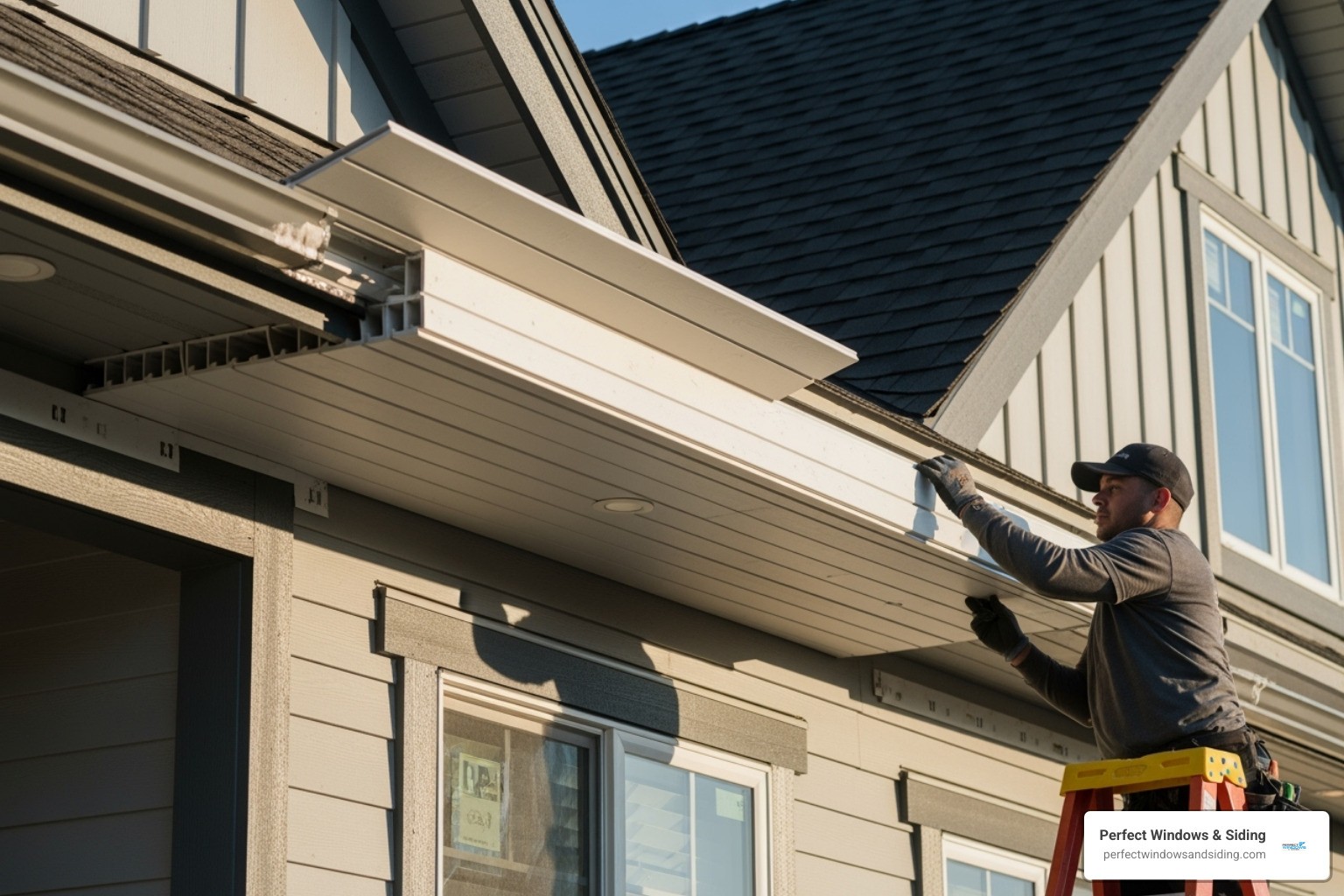
Safety comes first when we’re working on any installation project. Those 16-foot LP SmartSide panels are fantastic for creating seamless runs with fewer joints, but they’re also quite unwieldy. I always recommend having a helper when handling these longer pieces – trust me, your back will thank you later! Make sure your ladder or scaffolding is rock-solid, and don’t forget your safety glasses and gloves.
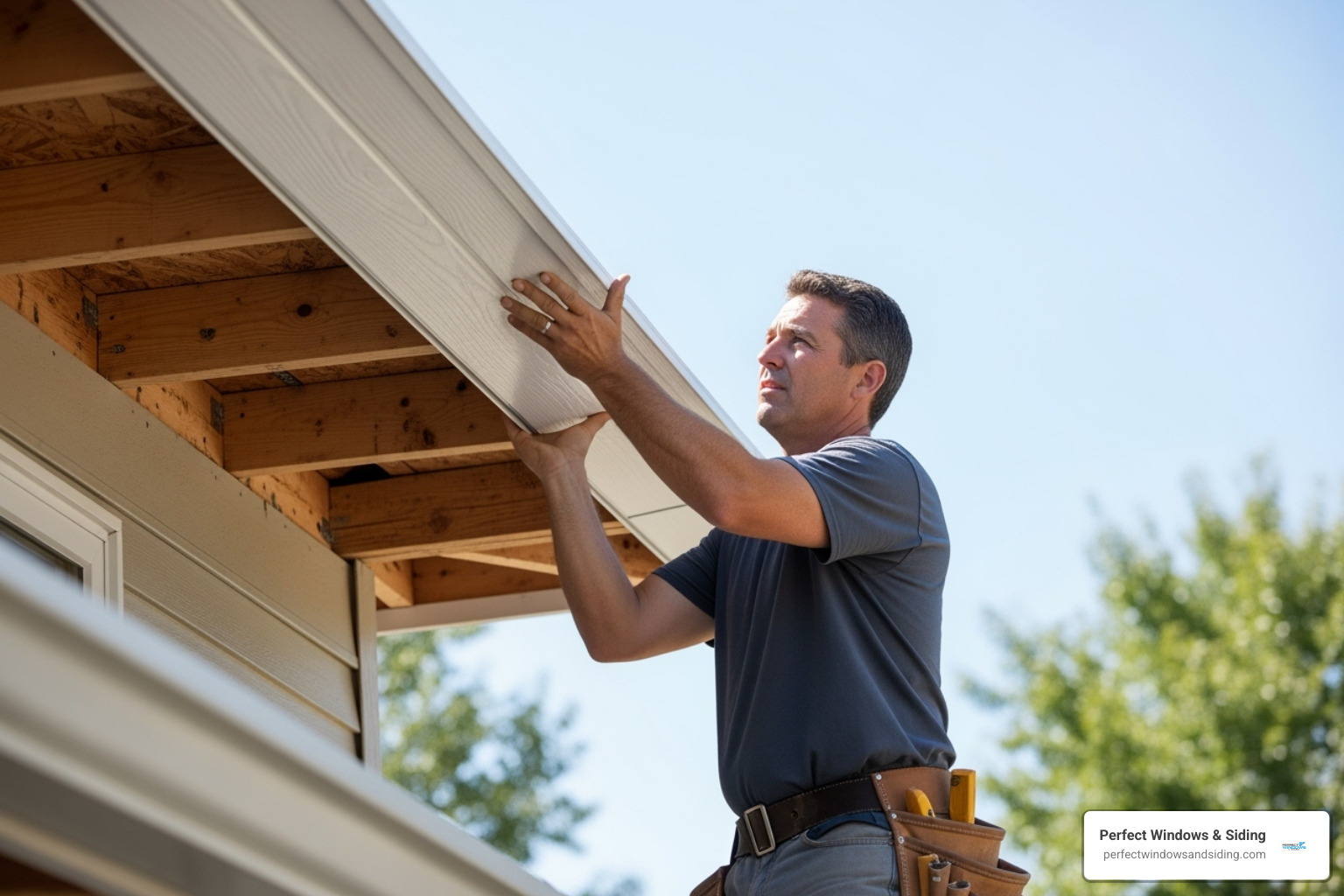
The key difference you’ll encounter is between open soffit applications (where the soffit acts as part of the structural roof system) and closed soffit applications (where it’s primarily decorative and functional for ventilation). Each approach has its own requirements, but both rely on the same fundamental principles of proper support and fastening.
Proper Nailing and Fastening for LP Soffit Installation
Getting the nailing right is absolutely critical for your LP soffit installation. I’ve seen too many DIY projects fail simply because someone skipped these details or tried to take shortcuts.
Hot-dipped galvanized nails are your best friend here. We’re talking about box-style nails with at least a .113-inch shank diameter and a .270-inch head diameter minimum. The length needs to be sufficient so the nail penetrates your structural framing by at least one and one-half inches – this isn’t negotiable.
Nail placement follows the “3/8-inch rule” – keep your nails 3/8 inch from all panel edges. Any closer and you risk splitting the material, especially near corners. For nail spacing, we go with 6 inches on center around the perimeter and 12 inches on center at intermediate supports. This creates a strong, even hold without overdoing it.
The biggest mistake I see? Overdriving nails. You want that nail head sitting flush or just barely snug against the surface. If you sink it more than 1/8 inch into the material, you’ve compromised the panel’s integrity. When this happens, seal the hole with exterior caulk and drive a new nail nearby – it’s worth the extra step.
For a visual walkthrough of these techniques, check out the LP SmartSide Installation Video Series. It’s incredibly helpful for getting these details right.
Installing in Open Soffit Applications
Open soffit installations are where your soffit panels actually become part of the roof’s structural system. This means we need to use LP’s Precision 76 or 190 Series products, which carry the APA Trademark stamps for structural applications.
The critical requirement here is supporting all four edges of every panel with solid blocking. Think of it as creating a complete frame around each piece – this blocking provides continuous nailing surfaces and maintains the structural integrity your roof depends on.
We maintain 1/8-inch spacing between panel edges and ends. This small gap is essential for allowing the engineered wood to move naturally with temperature and humidity changes without buckling or warping.
The nailing pattern follows our standard guidelines: 6 inches on center at edges and 12 inches on center along intermediate supports. Since these panels are doing structural work, precision in fastening becomes even more important.
Installing in Closed Soffit Applications
Closed soffit applications are more common in residential work, and they’re where we often get to be a bit more creative with trim details. J-channel or F-channel around the perimeter creates clean, professional-looking edges that integrate beautifully with your fascia and other trim elements.
Supporting panel ends and edges remains crucial, even though these aren’t structural applications. Every panel edge needs solid 2×4-inch or larger backing. If your existing framing doesn’t provide this, we add blocking between rafters to create proper nailing surfaces.
Spacing requirements are slightly different here – we use a minimum 3/16-inch gap at all ends and butt joints. This wider spacing accommodates the enclosed environment where moisture and temperature changes can be more pronounced.
After installation, those joints get filled with exterior-quality sealant meeting ASTM C920 Standard, Class 25 specifications. This creates a moisture barrier while remaining flexible enough to move with the material.
The beauty of closed soffit installations is how they clean up the entire roofline, creating that finished look that really makes a home stand out. For comprehensive exterior solutions that complement your new LP soffit, explore our Siding Chicago, IL services.
Finishing Touches and Special Considerations
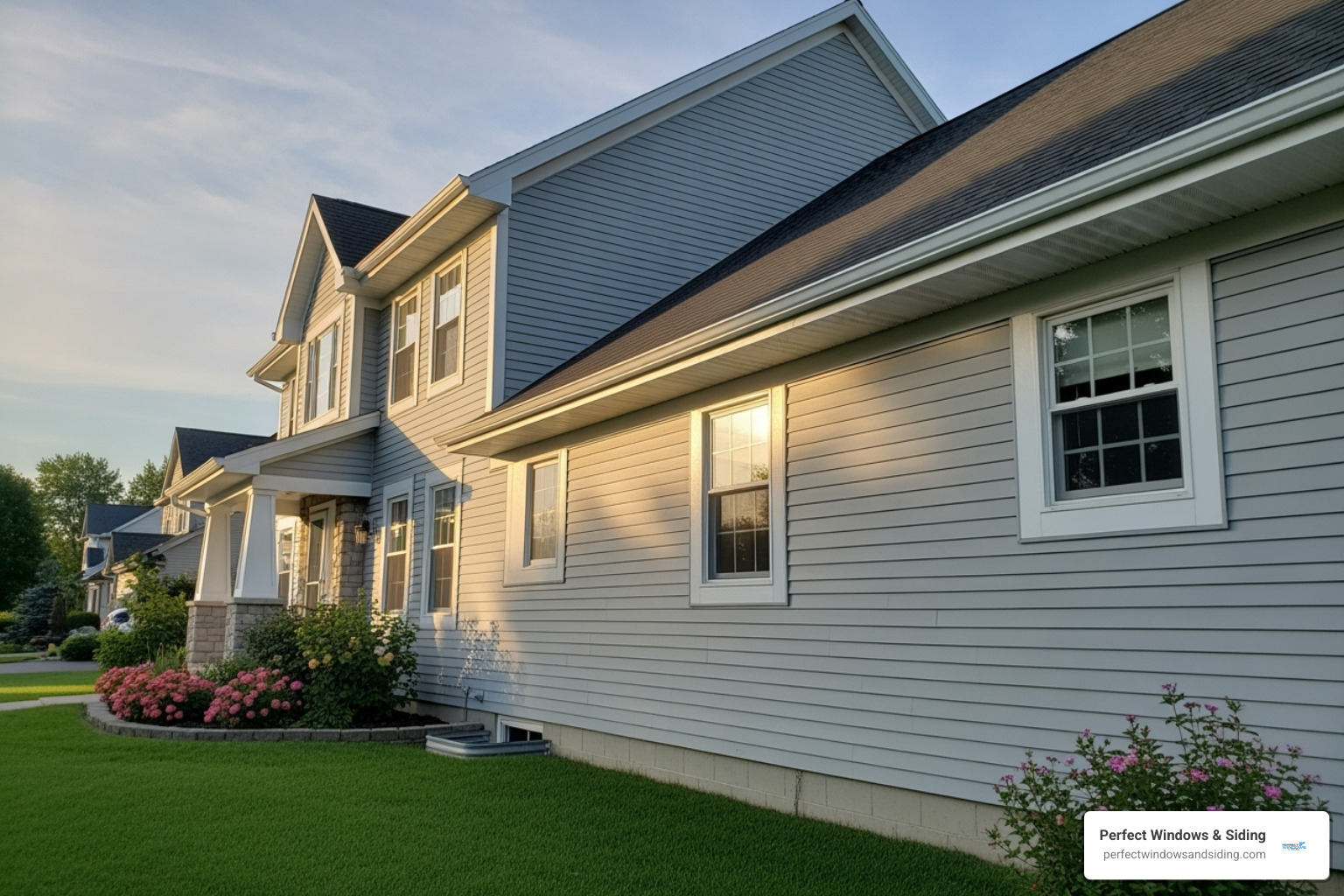
Once your beautiful LP SmartSide soffit panels are snugly in place, it’s time for the final touches that truly bring your home’s exterior to life and guarantee its long-lasting protection. Think of it as putting the icing on the cake – these steps ensure your LP soffit installation not only looks fantastic but performs flawlessly for years to come.
First up, caulking procedures are vital. Remember those small gaps we left for expansion? Now’s the time to seal them up tight! All end and edge joints should have a minimum of 3/16-inch space. After the soffit is installed, these little gaps need to be filled with an exterior-quality, non-hardening, paintable sealant that meets the ASTM C920 Standard, Class 25. This sealant is your first line of defense against moisture trying to sneak in.
Next, it’s time for painting requirements. While LP SmartSide products arrive primed, they absolutely need a final coat of paint. For the best protection and to keep your warranty valid, we always recommend a high-quality, 100% acrylic latex paint. You can also use semi-gloss or satin finish oil or alkyd paints. Make sure every exposed surface of the soffit, including the bottom edges and any cut ends, gets a thorough coat. This final paint job should happen as soon as possible, ideally within 180 days of your LP soffit installation.
Finally, let’s talk about priming exposed wood. This is a super important step that sometimes gets overlooked. Whenever you make a cut on an LP SmartSide product, you expose the engineered wood core. To keep things protected and maintain your warranty, you must prime these exposed areas before painting. This adds a crucial barrier against moisture, keeping your soffit strong and beautiful.
Handling Vented Soffit
If you opted for vented soffit – and we highly recommend it! – you’ve made a smart choice for your home’s health. Vented soffit is like the lungs of your attic, working hand-in-hand with ridge vents to create a continuous airflow. This helps prevent heat and moisture from building up, which can lead to nasty issues like mold, mildew, and even damage to your roof.
LP SmartSide vented soffit is specifically designed to provide excellent airflow, with options offering 5 or 10 square inches of ventilation per linear foot. When we install it, we always make sure to orient the panels in a way that maximizes this crucial airflow.
One key thing to remember is avoiding cutting through vents. When trimming vented soffit panels to fit, we carefully plan our cuts so we don’t accidentally slice through the pre-made vents. This keeps the ventilation system working perfectly. We aim to lay out and install your vented soffit in a way that avoids cutting into these vented areas as much as possible.
For corner installation techniques, especially with square-cut ends, we run the vented soffit right to the corner and butt the straight-cut edges together. Just make sure the vents aren’t closer than 3 inches from the end or corner to keep that vital airflow going and maintain structural integrity.
And a quick note on exhaust duct clearance: If you have exhaust ducts (from your bathroom or kitchen, for example) that exit near your soffit, ensure they are at least 3 feet in any direction from the openings in your vented soffit. This simple rule prevents moisture-laden air from being pulled right back into your attic – something you definitely want to avoid!
Considerations for High Wind and Fire-Rated Areas
Living in an area like Chicagoland means we sometimes face high winds, and that calls for extra care with your LP soffit installation. Similarly, if your home requires fire-rated assemblies, there are special considerations we need to keep in mind for safety.
In high-wind areas, local building codes might require heavier nailing schedules or specific fasteners to ensure your soffit can truly stand up to extreme weather. While LP SmartSide soffit is tough and designed to withstand winds up to 200 mph when installed correctly, we always double-check local requirements. Sometimes, the nail shank diameter and length might need to be larger based on the wind pressure, speed, and how exposed your home is.
For code compliance in fire-rated assemblies, it’s crucial to study the specific fire-rated plan before we even start. Products like LP FlameBlock sheathing are often key components in these fire-resistant wall assemblies. Soffit and eave details are incredibly important here because they can potentially trap heat or even provide a path for fire to spread.
That’s why we might use solid blocking in fire-rated applications. This could involve installing solid dimensional lumber blocking from the top plate all the way to the underside of the roof deck, or even solid dimensional blocking on the fascia and soffit itself. This creates a really robust, fire-resistant barrier between the soffit/eave and the rest of your home’s structure.
To dive deeper into these critical safety aspects, especially in fire-prone areas, you can always refer to LP’s detailed guide on Fire-rated Sheathing Installation: Soffit & Eave Details.
Common Mistakes and Comparisons
Even with the best intentions and careful planning, small oversights can sometimes creep into an LP soffit installation. But here’s the good news: knowing what to watch out for can help you avoid these pitfalls and ensure your soffit performs beautifully for years to come. Think of it as learning from experience, without having to make the mistakes yourself!
One of the most frequent issues we see is improper gapping. Remember how we talked about leaving a small space (like 3/16-inch) between panels? That’s not just a suggestion – it’s crucial! LP SmartSide, being an engineered wood product, will naturally expand and contract ever so slightly with changes in temperature and humidity. If you don’t leave those small gaps, the panels can buckle or push against each other, leading to an uneven or damaged finish.
Another common oversight is forgetting to seal cut edges. We can’t stress this enough: every single field cut you make on an LP SmartSide product exposes the raw engineered wood core. To maintain its integrity and, more importantly, its warranty, you must prime and paint these cut edges. Skipping this step leaves your soffit vulnerable to moisture, which is exactly what we’re trying to protect your home from!
Then there’s the classic overdriving nails. While you want fasteners to be snug and secure, driving nails too deep can crush the material, weaken its hold, and even create tiny depressions where moisture can collect. The goal is for the nail head to be flush with the surface, not embedded below it. If you accidentally over-drive a nail by more than 1/8″, it’s best to seal that spot and re-nail nearby.
Lastly, inadequate framing support is a foundational mistake. LP SmartSide soffit needs solid backing. If your existing framing isn’t straight or doesn’t provide continuous support for all panel ends and edges, you need to add blocking. Without that firm foundation, your soffit won’t be as stable or durable as it should be.
Here’s a quick comparison of LP SmartSide Soffit to other common soffit materials, highlighting why it’s such a fantastic choice:
| Feature | LP SmartSide Soffit (Engineered Wood) | Vinyl Soffit | Aluminum Soffit |
|---|---|---|---|
| Installation | Installs much like real wood, can be cut with standard tools, requires sealing of cut edges. | Lightweight, easily cut, snaps into channels, but can be prone to sagging in long spans. | Lightweight, easy to cut, but can dent easily and requires specific tools for crisp bends. |
| Durability | Highly resistant to impacts, hail, freeze/thaw cycles, and fungal decay; resists buckling. | Can become brittle in cold weather, prone to cracking or splitting from impacts; can sag over time. | Durable against rot and insects, but very susceptible to denting, bending, and can rattle in high winds. |
| Maintenance | Requires priming and painting of cut edges, then standard repainting over time. | Low maintenance, typically just washing, but colors can fade over time and repairs are difficult. | Low maintenance, typically just washing, but dents are permanent and paint can chip or scratch. |
| Aesthetics | Offers the authentic look and feel of real wood, with deep cedar grain texture, providing excellent curb appeal. | Often has a more plastic-like appearance; limited texture options. | Smooth, sometimes metallic finish; can look utilitarian; limited texture options. |
| Cost | Generally a mid-to-high range option, offering excellent value for its durability and aesthetic appeal. | Typically a lower-cost option, but may not offer the same longevity or aesthetic appeal. | Mid-range option, can be more expensive than vinyl, but often less than engineered wood or fiber cement. |
What are the warranty implications of improper installation?
This is a big one, and it’s something we always emphasize to our clients. Simply put, improper installation can void your warranty. LP SmartSide products come with a fantastic 5/50-year limited warranty, which means you get a 5-year, 100% labor and replacement feature, and a 50-year prorated limited warranty on the substrate. This is a huge peace of mind!
However, this warranty is contingent upon following LP’s detailed manufacturer instructions. If the soffit isn’t installed according to their guidelines – for example, if cuts aren’t sealed, gapping is incorrect, or nails are overdriven – you could inadvertently jeopardize your coverage. It’s like buying a car and then not following the maintenance schedule; you might void your protection. That’s why choosing experienced professionals for your LP soffit installation is so important. We ensure every step is done right, protecting your home and your investment. For more information on protecting your home with quality exterior products, check out our insights on Windows and Siding.
Planning soffit work as part of a wider siding project? Explore our siding services in Chicagoland.