


Why LP Panel Siding Installation is Perfect for Chicago Homes
LP panel siding installation is a durable and cost-effective way to upgrade your home’s exterior. This engineered wood product offers exceptional weather resistance and installs faster than many traditional materials, making it ideal for Chicago’s challenging climate.
Quick LP Panel Siding Installation Overview:
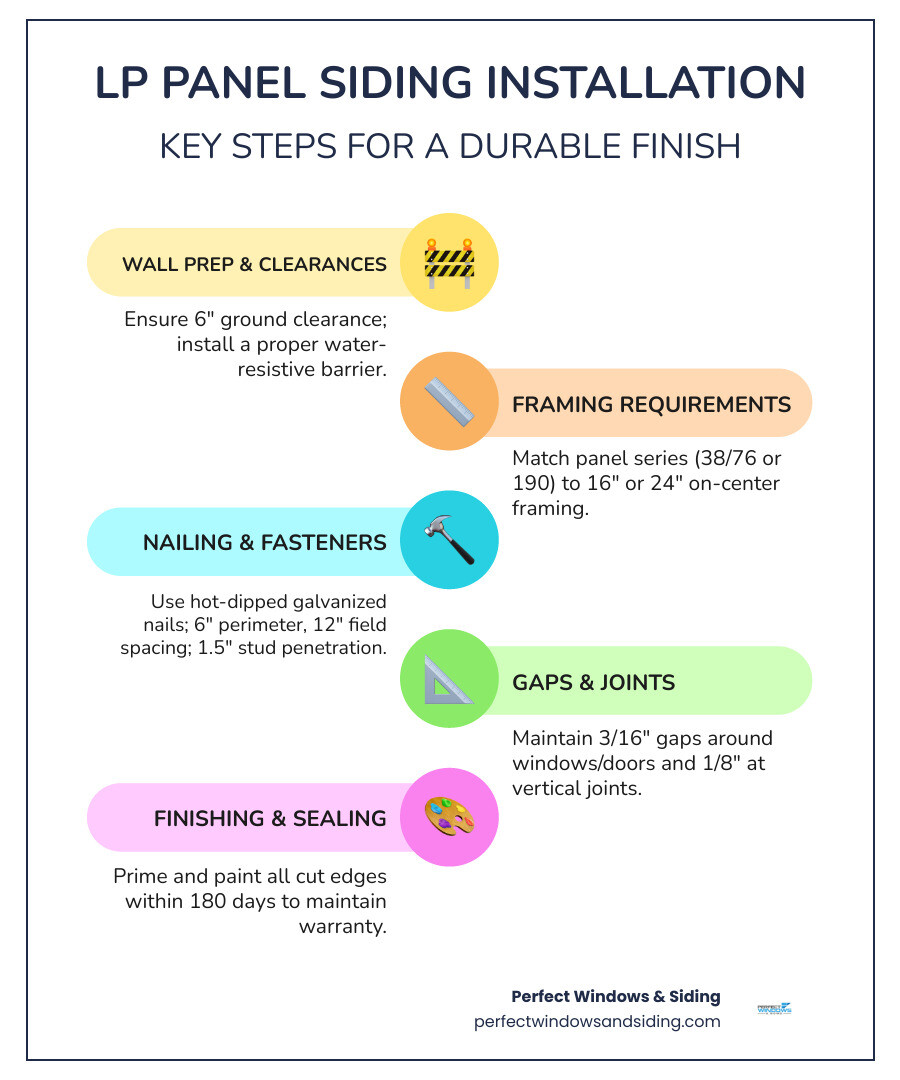
- Preparation – Maintain 6″ ground clearance, install water-resistive barrier
- Framing Requirements – Use 38/76 Series on 16″ centers or 190 Series on 24″ centers
- Nailing Pattern – 6″ spacing on perimeter, 12″ spacing in field areas
- Fasteners – Hot-dipped galvanized nails, minimum 1.5″ penetration into studs
- Gaps – Leave 3/16″ around windows/doors, 1/8″ at vertical joints
- Finishing – Prime and paint all cut edges within 180 days
LP SmartSide panels feature built-in shiplap edges that save time and money during installation. The key to success lies in proper preparation, correct fastening, and following manufacturer specifications. The panels are designed to withstand Chicago’s harsh winters and humid summers while maintaining their appearance for decades.
I’m Voytek Glab, owner of Perfect Windows & Siding. With over 20 years specializing in LP panel siding installation across Chicagoland, my experience on hundreds of projects ensures a long-lasting, warranty-compliant installation for your home.
Know your lp panel siding installation terms:
Pre-Installation: Gathering Your Tools and Prepping the Walls
Proper preparation is everything for a successful LP panel siding installation. Taking the time upfront to gather the right tools and prep your walls correctly will save you headaches and money down the road.
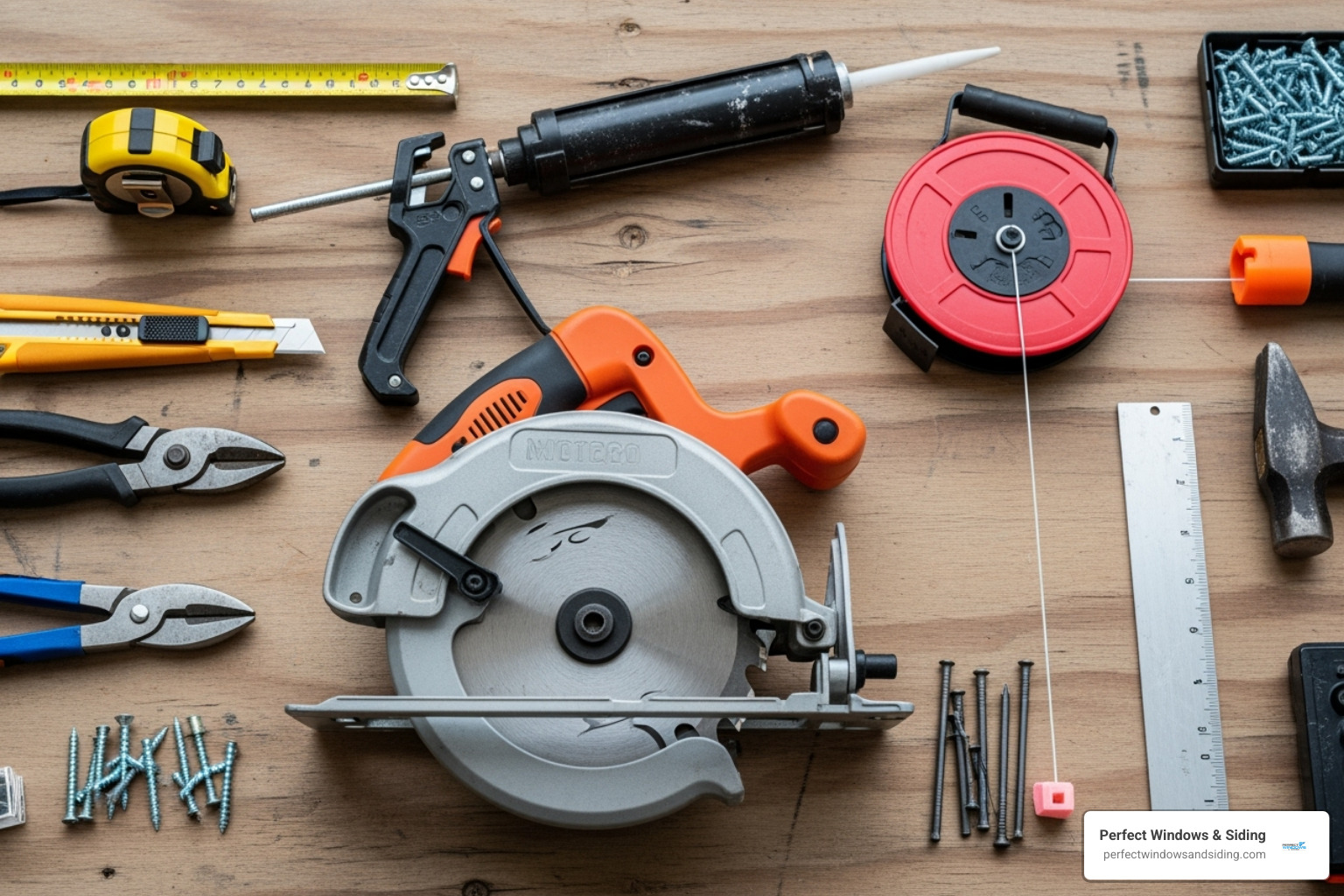
Essential Tools and Materials
Having the right tools ensures a professional-looking and safe installation. Quality tools make all the difference.
- Circular Saw: Use a sharp, fine-tooth blade designed for engineered wood. A pro tip: use a “climb cut” where the blade rotation cuts downward on the primed surface to prevent chipping.
- Chalk Line & Level: Essential for keeping panels perfectly straight and plumb.
- Caulking Gun: A comfortable gun is important for sealing gaps around windows and doors.
- Safety Gear: Always use safety glasses and a dust mask. Engineered wood dust can be an irritant.
- Tape Measure & Utility Knife: Non-negotiables for accurate measurements and cutting house wrap.
- Fasteners: Use hot-dipped galvanized box-style nails to resist corrosion. A nail gun will speed up the job, but be careful not to overdrive the nails.
- Sealant & Finishes: Your sealant must meet ASTM C920 standards (minimum Class 25) and be paintable. You’ll also need quality primer for all field cuts and 100% acrylic latex exterior paint for the final coat.
- Flashing: Have Z-flashing on hand for proper water management.
For homeowners considering a complete exterior makeover, our comprehensive siding services cover everything from material selection to final cleanup.
Understanding Panel Types and Framing
Matching the right panel series to your framing is required for warranty compliance and structural integrity.
| LP Panel Series | Recommended Framing (On-Center) | Nailing Procedure for Shear Value |
|---|---|---|
| 38 Series | 16 inches O.C. only | Double Nailing for 5/16″ Shear |
| 76 Series | 16 inches O.C. only | Single Nailing for 5/16″ Shear |
| 190 Series | 16 inches O.C. or 24 inches O.C. | Single Nailing for 5/16″ Shear |
If your home has 16-inch on-center framing, you can use any series. However, the 38 Series requires double nailing at each stud to meet structural shear requirements, while the 76 and 190 Series only need single nailing.
For 24-inch on-center framing, your only option is the 190 Series. Using other panels will not meet code and could void your warranty.
LP panels can be installed directly over code-approved nailable sheathing or straight to framing. If using wood structural panel sheathing, ensure it’s a minimum 7/16 Category with an APA Trademark Stamp to handle Chicago’s wind loads.
Critical Clearances and Wall Preparation
Getting clearances right protects your investment from moisture damage and ensures your warranty stays intact.
- Ground Clearance: A minimum of 6 inches is required between the siding’s bottom edge and the finished grade. This prevents moisture wicking from the soil.
- Concrete Clearance: Maintain at least 1 inch of clearance from surfaces like patios and walkways.
- Roofline Clearance: Leave a minimum 1-inch gap where siding meets the roofline to prevent water pooling and allow for expansion.
- Window and Door Clearances: Cut openings with a 3/16-inch gap on the sides and bottom, and a 3/8-inch gap at the top to accommodate flashing. These gaps are sealed later but are essential for water management.
- Water-Resistive Barrier (WRB): Always install a breathable WRB behind LP SmartSide. This secondary moisture protection integrates with your flashing to defend against water intrusion.
- Flashing: Install Z-flashing above windows and at horizontal transitions before the siding goes up. Leave a 3/8-inch gap above Z-flashing. Never seal spaces where flashing is integrated, as this can trap moisture.
For complete technical specifications, always reference the official SmartSide Installation Instructions | LP Building Solutions. It’s our go-to resource for ensuring every LP panel siding installation meets manufacturer standards.
The Step-by-Step LP Panel Siding Installation Process
With the prep work done, it’s time to hang the panels. This is where LP panel siding installation comes to life. Success here requires patience and precision.
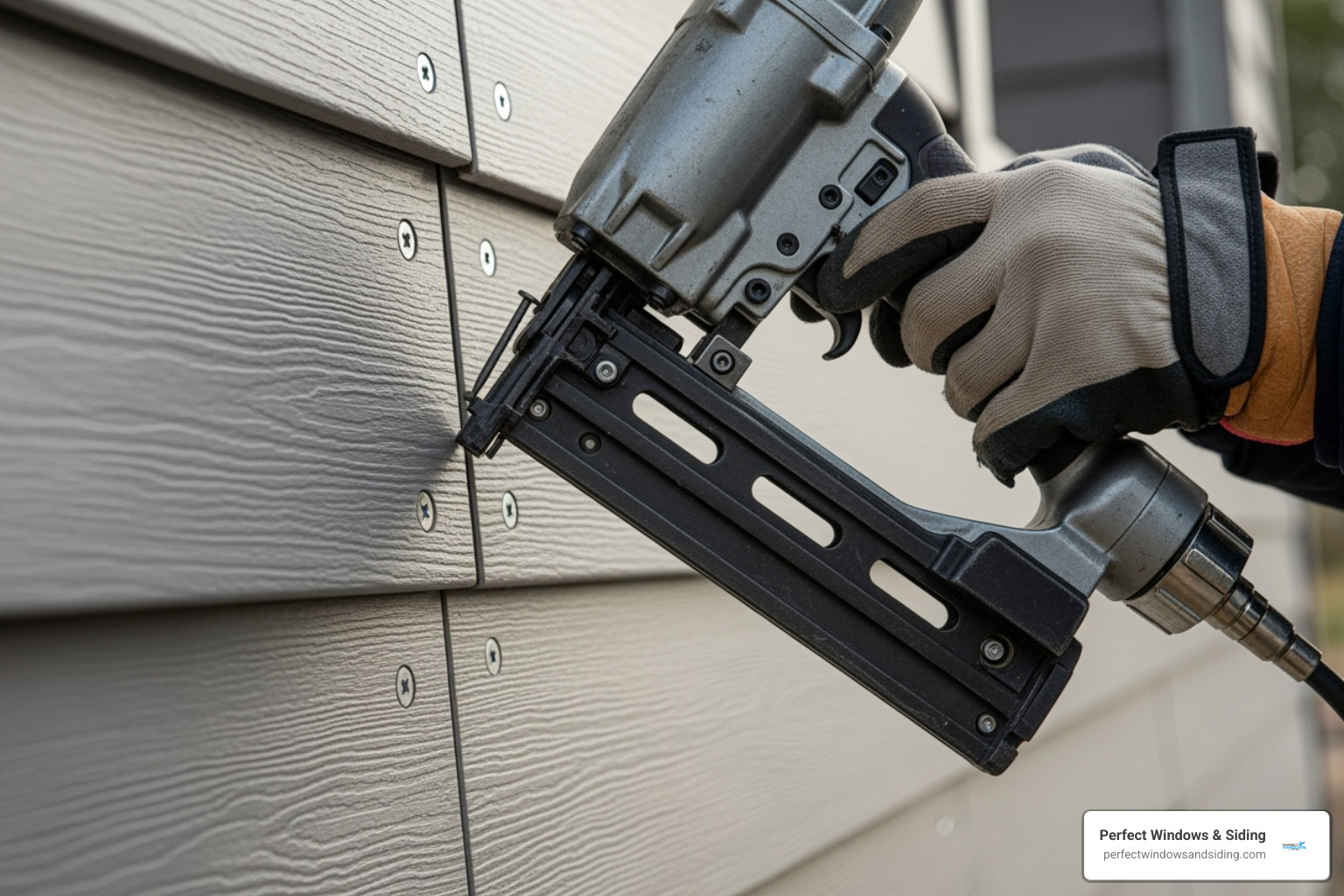
Nailing Patterns and Fastener Specifications
The fastening technique is critical for a successful LP panel siding installation.
- Fastener Type: Always use hot-dipped galvanized box-style nails. Avoid cheaper electroplated nails that can corrode. Use minimum 6d nails for 38/76 Series panels and 8d nails for 190 Series panels. Nails should have a minimum .113-inch shank and .270-inch head diameter.
- Nail Penetration: Nails must penetrate the structural framing by at least 1-1/2 inches. This is required to withstand Chicago’s high winds.
- Nailing Pattern: Space nails no more than 6 inches apart around the entire perimeter of each panel. For field nailing (intermediate studs), space nails a maximum of 12 inches apart.
- Nail Depth: Set your nail gun so the nail head is snug or flush with the siding surface. If you overdrive a nail by more than 1/8 inch, you must seal the hole and renail it.
For shiplap-edged panels, a double nailing technique along the overlap creates an incredibly strong connection.
Cutting and Fitting Panels Around Openings
Windows and doors are the most vulnerable spots for water infiltration, so precision is key.
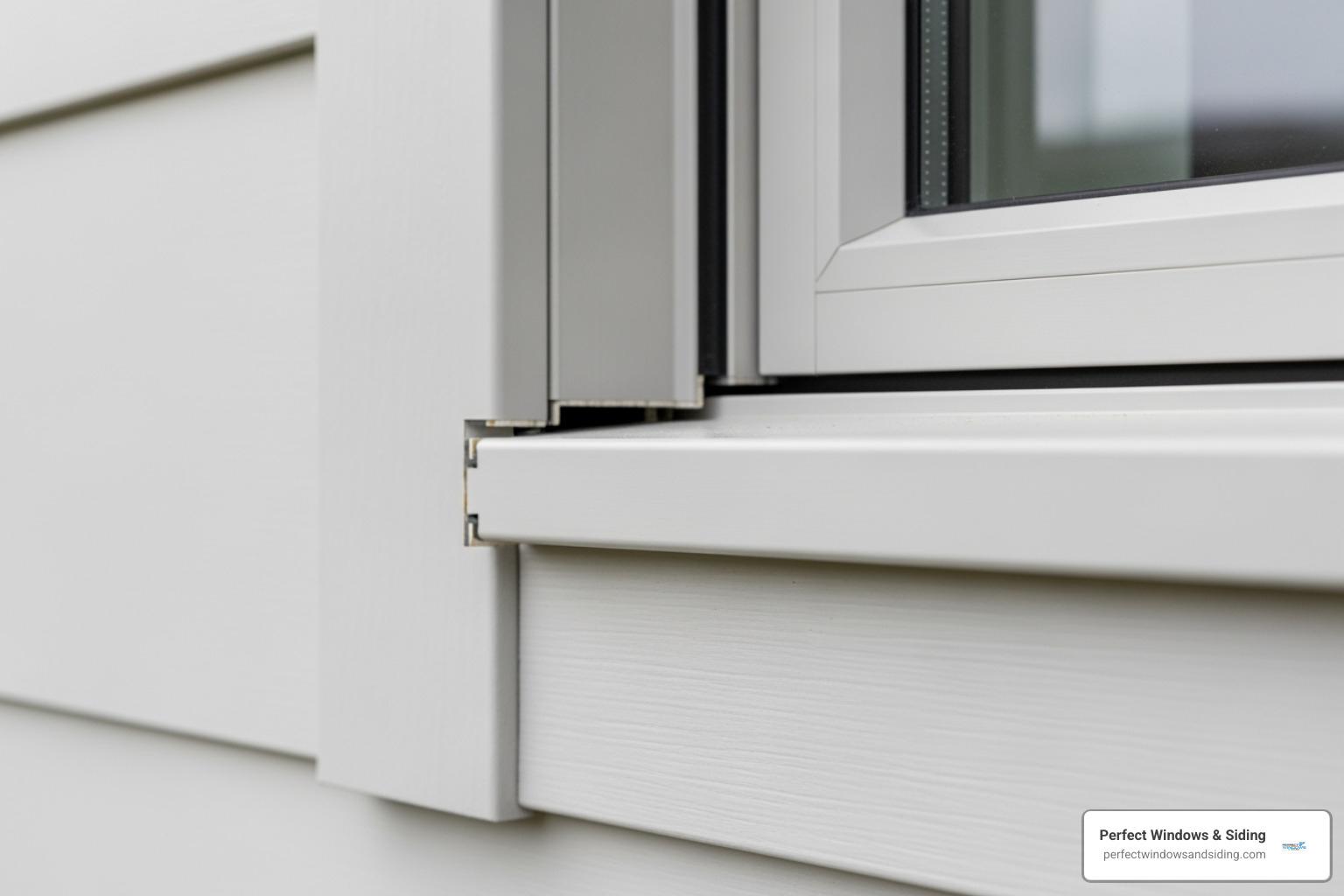
Always measure twice and cut once. For straight cuts, a circular saw works well; remember to “climb cut” to minimize chipping on the finished surface. For detailed work, a router provides clean, precise edges.
- Window Gaps: Cut openings with a 3/16-inch gap along the sides and bottom, and a 3/8-inch gap along the top. The larger top gap is necessary for proper flashing installation.
- Door Gaps: Follow the same 3/16-inch rule where siding meets trim.
- Z-Flashing: Install Z-flashing above every window as a primary defense against water. Maintain a 3/8-inch space between the flashing and the siding edge above it. Never apply sealant in flashed spaces to allow water to drain.
Handling Horizontal and Vertical Joints
Proper joint treatment is the mark of a professional installation.
- Shiplap Edges: These engineered edges allow panels to overlap neatly, creating clean seams and preventing moisture intrusion. Ensure panels are level so these edges land on stud centers.
- Vertical Butt Joints: Where two panels meet end-to-end, leave a 1/8-inch gap to accommodate natural expansion and contraction.
- Horizontal Joints: Treat any horizontal joint with Z-flashing. Install flashing above the lower panel, then leave a 3/8-inch gap before installing the upper panel to direct water out.
- Stagger Joints: Always stagger vertical joints across different courses for a professional look and improved structural integrity.
When investing in quality materials like LP SmartSide, trust our team of engineered wood siding contractors near me to get every detail right.
Finishing and Best Practices
Once the panels are in place, the finishing touches protect your investment and bring out the beauty of your new siding. These final steps are what separate a good LP panel siding installation from a great one.

Sealing, Caulking, and Painting for Longevity
The final steps of an LP panel siding installation are crucial for protection and warranty compliance.
- Seal Cut Edges: This is the most critical step. Every time you cut an LP SmartSide panel, you expose the wood substrate. This exposed edge must be primed and painted to prevent moisture absorption. Skipping this step will void the warranty.
- Primer and Paint: Use a high-quality exterior primer on all cut edges. For the topcoat, use only 100% acrylic latex paint or a semi-gloss/satin oil or alkyd paint. Do not use semi-transparent stains or paints with vinyl-based resins, as they are incompatible with LP SmartSide.
- Caulking: Seal all gaps—the 3/16-inch spaces around windows/doors and the 1/8-inch vertical butt joints—with a high-quality, paintable sealant that meets ASTM C920, minimum Class 25. This flexible sealant prevents cracking over time. Also, maintain and seal a 3/8-inch vertical gap where siding meets other materials like brick or stone.
- The 180-Day Rule: This is a strict warranty requirement. All exposed surfaces, especially cut edges, must be fully primed and painted within 180 days of installation.
Understanding the finishing process is key to understanding why new siding is worth the investment. It’s about protecting your home’s structure for decades.
Advanced Considerations and Code Compliance
Real-world LP panel siding installation projects often present unique challenges, from thick foam insulation to specific code requirements. Here’s how to handle more complex scenarios.
Installing Over Foam Insulation or Existing Siding
Not every installation is on clean sheathing. Here’s how to handle foam insulation or existing siding.
- Over Rigid Foam (up to 1 inch): Use longer nails to achieve the required 1-1/2 inch penetration into the structural framing.
- Over Rigid Foam (exceeding 1 inch): You must install furring strips (typically 1-1/2″ thick) over the foam. Fasten these strips to the structural framing (max 16″ O.C.) to create a solid nailing base. This also creates a beneficial rainscreen effect, improving ventilation and moisture management.
- Over Existing Siding: You can install new LP SmartSide over old wood or composite siding if the surface is flat. A proper water-resistive barrier must be installed between the old and new layers.
LP SmartSide panels also contribute to your home’s wall bracing. The nailing procedure (single or double) depends on the panel series and helps the wall meet required shear values.
Meeting Building Codes and Warranty Requirements
Following building codes and manufacturer warranties is not optional; it’s essential for protection and performance.
- Fire-Rated Assemblies: In certain areas, special installation is required. This involves using fire-retardant sealant and a more intensive nailing pattern (3″ O.C. on the perimeter, 8″ O.C. in the field). While not common in Chicago, it shows the system’s capability.
- Wind Resistance: The standard nailing pattern (6″ perimeter, 12″ field) is engineered to handle the strong winds common in our region.
- Shear Wall Values: Proper nailing directly impacts your home’s ability to resist lateral forces from wind. The correct technique is crucial for structural stability.
- Warranty Implications: LP’s warranty is voided if application, finishing, and maintenance instructions are not followed precisely. As Pella® Platinum Certified contractors, we are meticulous about every detail to protect your investment.
We consistently reference the latest LP guidelines, from material storage to paint formulations, to ensure full warranty compliance. If you’re exploring other options, we also specialize in Hardie Board Siding Installation, which has its own specific requirements.
For a visual guide, LP provides an excellent resource: [VIDEO] LP® SmartSide® Panel Application Tips & Tricks.
Frequently Asked Questions about LP Panel Siding Installation
After two decades of LP panel siding installation projects in Chicagoland, I’ve heard every question. Here are the most common ones.
How much clearance does LP SmartSide panel siding need from the ground?
You need a minimum of 6 inches between the siding’s bottom edge and the finished ground level. This is critical to prevent the siding from wicking up ground moisture, which can lead to swelling and damage. I’ve seen siding jobs ruined because this rule was ignored.
For hard surfaces like concrete patios or walkways, you still need at least 1 inch of clearance to ensure proper water drainage and prevent splash-back during heavy rains.
What is the correct nailing pattern for LP SmartSide panels?
The correct nailing pattern is essential for structural integrity and warranty compliance. Nails should be spaced a maximum of 6 inches apart around the entire perimeter of each panel and a maximum of 12 inches apart on intermediate studs in the field (the middle area).
The perimeter includes all four edges. This pattern creates a strong attachment to withstand high winds. The field nailing provides stability and prevents buckling. This pattern is a requirement, not a suggestion.
Do I have to paint the cut edges of LP SmartSide panels?
Yes, absolutely. This is a non-negotiable part of LP panel siding installation. Every field-cut edge must be primed and then painted with high-quality, 100% acrylic latex paint. Failing to do this will void your warranty.
Cutting the panel exposes the inner wood substrate, which can absorb moisture like a sponge if left unsealed. This can lead to swelling and delamination. You have 180 days from installation to complete the painting, but we recommend doing it as soon as possible to ensure your investment is protected.
Conclusion
It’s clear why LP panel siding installation is a popular choice for Chicago homeowners. It offers a winning combination of durability, beauty, and efficient installation, making it ideal for our challenging Midwest weather.
A successful installation hinges on following the manufacturer’s guidelines. Key details like the 6-inch ground clearance, the correct nailing patterns (6 inches on perimeter, 12 inches in the field), and priming and painting all cut edges within 180 days are non-negotiable for performance and warranty protection.
As a siding installer in Chicagoland for over two decades, I can attest that LP SmartSide consistently delivers on its promises. The engineered wood construction provides excellent stability, and the shiplap edges make for a clean, professional installation.
At Perfect Windows & Siding, our family-owned business has built its reputation on getting these details right. A quality LP panel siding installation transforms a home’s appearance, value, and weather resistance.
Ready to give your home the protection and curb appeal it deserves? Contact us for your siding project and let’s turn your vision into reality!