


Why Custom Iron Entry Doors Transform Your Home’s First Impression
Learning how to install custom iron entry doors gives you the power to create a stunning entrance that combines best security with timeless elegance. These handcrafted doors, typically made from 12-gauge steel, offer superior durability compared to wood or fiberglass options while requiring minimal maintenance over their lifetime.
Quick Installation Overview:
- Prepare the rough opening (1″ wider and taller than door frame)
- Set and secure the door jamb with silicone sealant and lag screws
- Hang the heavy door panels (requires 2 people, remove glass first)
- Shim and adjust for perfect alignment and smooth operation
- Seal and insulate gaps for weatherproofing
The installation process typically takes 4-6 hours depending on whether it’s new construction or a remodel. Most iron doors weigh significantly more than standard doors, so having a helper is essential for safe handling.
“Installing our iron doors is very simple and quick! It only takes 2 people within 2 hours to install a set of double iron doors,” notes one manufacturer’s installation guide, though this timeline can vary based on your specific situation and experience level.
Custom iron doors offer several key advantages over traditional materials. Unlike wood doors that require repainting every 2-3 years, iron doors are naturally resistant to moisture, rot, fire, and insects. They also provide improved security through their solid steel construction and can be customized with various glass options, finishes, and decorative scrollwork.
I’m Voytek Glab, owner of Perfect Windows & Siding, and I’ve helped Chicago homeowners install custom iron entry doors for over 20 years. My hands-on experience with these heavy, precision-crafted doors has taught me the techniques that ensure a professional result every time.
Before You Begin: Pre-Installation Essentials
Think of this phase as laying the groundwork for success. Just like you wouldn’t start cooking without reading the recipe and gathering your ingredients, you shouldn’t begin to install custom iron entry doors without understanding what you’re working with and having everything ready to go.
Understanding Your Custom Iron Door
Your custom iron door is a handcrafted masterpiece. The foundation of its quality is the 12-gauge steel construction. While some manufacturers use thinner 14 or 16-gauge steel, 12-gauge offers superior durability and security, strong enough to withstand Chicago’s harsh weather.
Customization options are virtually limitless. Finishes range from classic oil-rubbed bronze to sleek matte black. Glass options can transform your entrance; choose clear tempered glass for maximum light or textured, frosted, or decorative designs for privacy. The scrollwork designs are where artistry meets craftsmanship, with styles from elaborate, old-world patterns to clean, geometric lines.
For the Chicago area, thermal break technology is essential. Standard iron doors can transfer cold, leading to interior condensation. A thermal break creates an insulating barrier within the door, dramatically reducing heat transfer for better energy efficiency.
Understanding these features helps you appreciate the investment you’re making in your home’s future. If you’d like to explore the full range of possibilities, learn more about custom entry doors in Chicago.
Gathering Your Tools and Materials
Having the right tools ready prevents headaches and ensures a smooth installation. Custom iron doors demand precision, and the right equipment makes all the difference.

Your essential toolkit should include a level, drill and impact driver, shims, exterior-rated silicone caulk, lag screws (3/8″ x 3″), a hammer, measuring tape, safety glasses, and gloves. You’ll also need a pry bar, utility knife, sawhorses, grease for the hinges, and painter’s tape.
Unpacking precautions are critical. These doors arrive in sturdy wooden crates. When cutting packaging or prying open the crate, work slowly and carefully to avoid scratching the door’s finish. One careless slip can damage your beautiful new door.
Why you need a helper isn’t a suggestion—it’s a safety requirement. Custom iron doors are incredibly heavy, often weighing several hundred pounds. Attempting to handle these alone is dangerous. Plan to have at least two capable helpers.
Preparing the Rough Opening
A perfect installation starts with a perfect foundation. The rough opening needs to be exactly 1 inch wider and 1 inch taller than your door frame’s overall dimensions. This extra space is crucial for shimming and adjustments.
Your opening must be level and plumb. Check that the floor is level, the vertical sides are plumb, and the top is level. Verify the opening is square by measuring diagonally from corner to corner; both measurements should match exactly. Any deviation will complicate the installation.
Sill pan installation is your insurance against water damage. This waterproof tray sits under the threshold and directs any water safely outside. Proper flashing for water protection creates a continuous barrier around the opening, overlapping to shed water away from your home’s structure.
For additional insights on door preparation principles, a guide to installing prehung exterior doors offers valuable perspective on rough opening fundamentals.
The Ultimate Guide to Install Custom Iron Entry Doors
Alright, here’s where the rubber meets the road! Now that you’ve prepared your space and gathered your tools, it’s time for the main event. Follow these steps for a secure, weatherproof, and professional-looking installation that will last a lifetime. This is where the magic (and a bit of muscle) happens!
Step 1: Setting the Door Jamb
The door jamb is the frame that will cradle your iron door for decades. Getting this step right is crucial. Start with a dry fitting of the frame. Carefully lift the jamb into the rough opening (without the door panels) to check the fit. This test run lets you spot any issues before committing to the permanent placement.
Once you’re happy with the fit, apply silicone sealant generously to the sub-floor where the threshold will sit. This creates a waterproof barrier to prevent moisture from getting under the door.
Now, carefully lift the door jamb back into position, ensuring it’s centered both horizontally and vertically. Use shims to make the jamb perfectly plumb and level. Start by shimming the threshold until it’s level, then work up the sides, shimming at the top, middle, and bottom. Once aligned, temporarily secure the jamb with a few screws through the mounting tabs into the framing.
Step 2: Hanging the Heavy Iron Doors
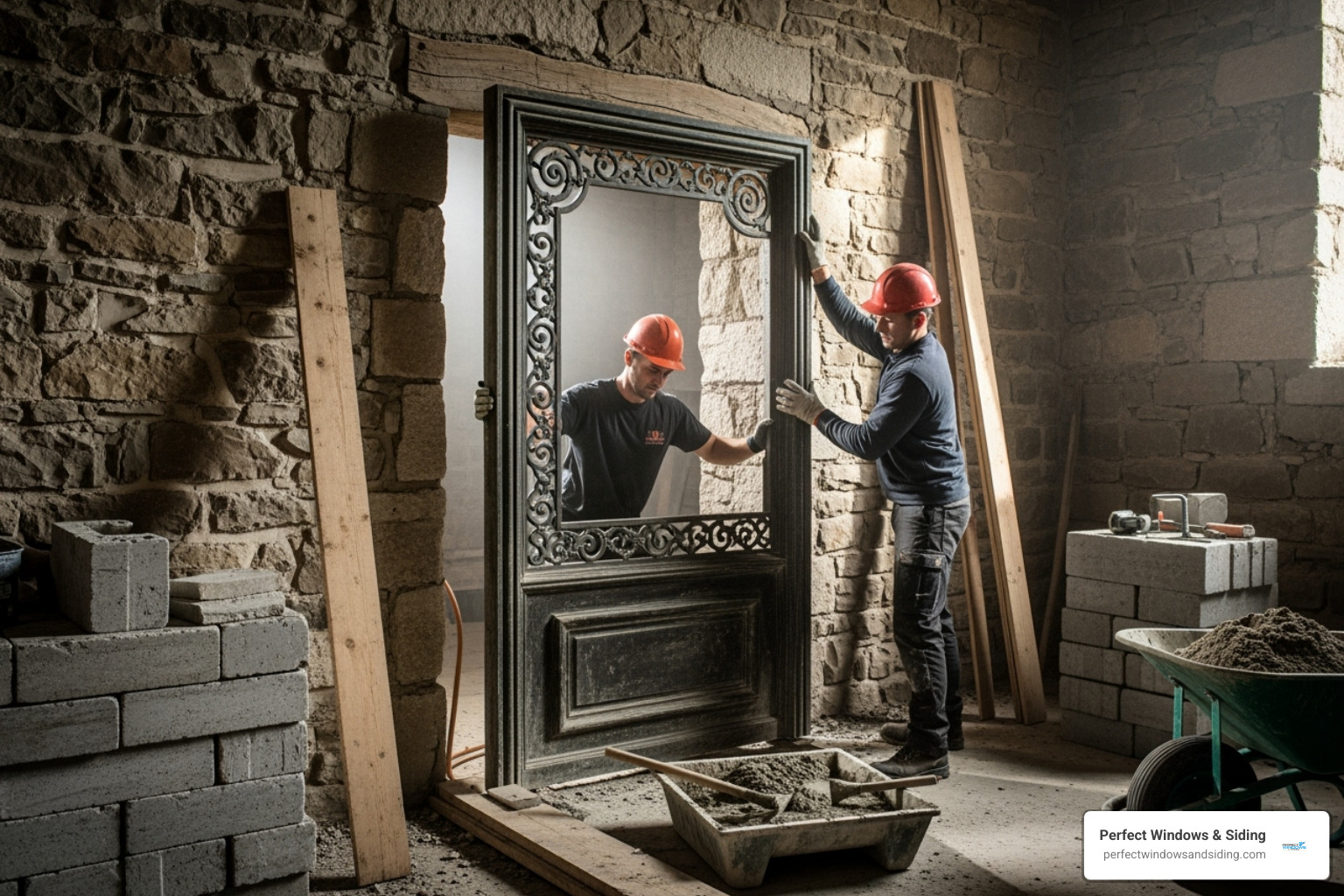
This is the most challenging part of learning how to install custom iron entry doors. The sheer weight of these doors demands precision and teamwork. A two-person lift is absolutely required; for double doors, three people are recommended. These solid steel doors can weigh hundreds of pounds, and attempting to lift one alone is dangerous.
Before lifting, grease those hinges. A small dab of grease on the hinge pins ensures smooth operation from day one. A pro tip: if your door has removable glass panels, take them out before hanging. This can significantly reduce the weight, making the door more manageable. Handle the glass panels with care and set them somewhere safe.
When lifting, approach the jamb with the door at a 90-degree angle, as if it were fully open. This angle helps you slide the door slab onto the jamb’s hinge pins. You and your helper must align all hinge barrels simultaneously.
If you’re installing double doors, always hang the non-active door first. This is the door that typically stays closed with flush bolts. Once installed and secured, it provides a solid reference for aligning the active door, ensuring both panels work together perfectly.
Step 3: Securing and Shimming for a Perfect Fit
Now it’s time for the fine-tuning that ensures your door operates smoothly for years. Close the doors and check the door reveals—the gaps around the edges. They should be even all the way around. If not, you’ll use shims to adjust.
Shimming at hinge locations is key. Insert shims between the jamb and the rough opening’s framing to make subtle adjustments. Place shims behind each hinge point to distribute the door’s weight evenly and prevent stress.
Once the reveals are perfect and the frame is plumb and square, secure it permanently with 3/8″ lag bolts. These heavy-duty fasteners are designed to handle the weight. Drive them through the pre-drilled holes in the mounting tabs into your home’s structural framing.
Always pre-drill pilot holes to prevent splitting the wood studs. Install these fasteners at the far outside edge of the mounting tabs. This placement provides maximum leverage and support, which is essential for preventing future door sag.

Step 4: Final Adjustments and Sealing
You’re in the home stretch! This final stage ensures your door looks fantastic, functions flawlessly, and protects your home from the weather. If your door has roller catches, fine-tune them using the adjustment screws so the door closes smoothly. Check that flush bolts engage and disengage easily; adjust the strike plate or lubricate if needed.
Next, fill those gaps with low-expansion foam between the door jamb and the framing. This seals out drafts and adds insulation. Use only “low-expansion” foam, as regular expanding foam can bow the jamb.
The final touch is caulking the exterior trim. Run a neat bead of high-quality, exterior-grade silicone caulk around all edges of the trim to create a watertight seal.
Seeing these steps in action can be incredibly helpful, which is why we’ve documented our process. You can see our exterior door installation process to get a visual guide to these crucial final steps.
DIY vs. Professional Installation: Making the Right Choice
Installing an iron door is a significant project that requires careful consideration. While the idea of tackling this yourself might seem appealing, it’s important to honestly assess whether this is the right path for your situation.
The Rewards and Risks of a DIY Install
The sense of accomplishment from a successful DIY installation is genuinely rewarding. The potential cost savings on labor can also be attractive when you’re already investing in a premium product.
However, the challenges are significant. The heavy lifting risk is serious, as these doors weigh several hundred pounds. A wrong move could cause injury. The complexity of adjustments is far greater than with a standard door; getting an iron door perfectly plumb, level, and sealed requires experience. Small mistakes can lead to drafts, moisture, or a door that won’t close properly.
There is also a high risk of damaging the door or frame. The beautiful finishes can be easily scratched or dented during installation. Finally, many manufacturers require professional installation to maintain their warranty. A DIY install could mean potentially voiding the warranty on your investment.
When to Call a Professional for your Custom Iron Entry Doors
Sometimes the smartest move is recognizing when to call an expert. If you have a lack of experience or tools, this is not an ideal first-time project. The specialized knowledge and equipment are essential. Similarly, if you don’t have a reliable, strong helper, the job becomes unsafe.
Complex openings with sidelights or transoms increase the difficulty exponentially, requiring expert-level skill to align multiple heavy components and ensure a weatherproof seal.
At Perfect Windows & Siding, we install custom iron entry doors to ensure your lifetime warranty remains intact. Professional installation protects your investment and provides peace of mind that the job is done right. After over 20 years of installing doors in Chicagoland, we’ve perfected the techniques to guarantee a flawless result.
As a local, family-owned business, we understand every homeowner’s situation is different. We’re happy to discuss your project and help you make the best decision. If you’re ready to explore professional installation, you can Find home door installation near me right here in the Chicago area.
Frequently Asked Questions about Installing Iron Doors
After helping Chicago homeowners install custom iron entry doors for over two decades, I’ve heard just about every question you can imagine. Let me share the answers to the most common ones that come up during our consultations.
How long does it take to install a custom iron door?
Installation time varies based on the project. For new construction with a prepared opening, installation typically takes about 4 hours. Remodels can take 6 hours or more because they involve removing the old door and potentially adjusting the existing opening. We often find the old frame isn’t square or has hidden rot that needs repair.
This does not include removing the old door or any necessary frame repairs. Extensive structural work, custom trim, or coordinating with other trades will add to the timeline. For a remodel, it’s wise to plan for a full day.
Should I use screws or nails to install an iron door frame?
Always use screws—specifically, heavy-duty 3/8″ x 3″ lag screws. There are several critical reasons for this.
First, screws provide superior strength to handle the immense weight of an iron door, whereas nails can loosen over time. Second, screws prevent sagging over time. Doors installed with nails often begin to drag or latch improperly as the fasteners work loose. Finally, screws allow for fine-tuning adjustments during installation. You can easily back out a screw to adjust the jamb’s position, which is nearly impossible to do cleanly with a nail.
My new iron door is hard to close. Is this normal?
Yes, this is normal and a sign that your door is doing its job. New weatherstripping is very stiff and creates a tight seal, which is essential for energy efficiency in Chicago’s climate. Think of it like a new pair of leather shoes that need a break-in period.
It will compress over the first few months of use, making the door easier to close and lock. During this time, you may need to give the door a firm push to latch it completely. This tight seal is what keeps your home comfortable and your energy bills down. If the door is still difficult to operate after three months, a minor adjustment to the strike plate may be needed, but in most cases, patience is all that’s required.
Conclusion: Enjoy Your Grand New Entryway
Stepping back to admire a freshly installed custom iron entry door is a magical moment. You’ve done more than just add a new entrance—you’ve transformed your home’s personality with a piece of functional art.
Whether you chose the DIY route or called in professionals, the result is a stunning entryway that improves your home’s curb appeal, security, and value. The robust 12-gauge steel construction will outlast many other elements of your home, requiring minimal maintenance.
Your new door is working for you 24/7, providing superior security, improving energy efficiency with its tight seals and thermal break, and freeing you from the regular maintenance of other door materials. No more repainting or worrying about warped panels during Chicago’s weather swings.
For over 20 years, we at Perfect Windows & Siding have shared in the pride homeowners feel seeing their vision perfectly executed. Your investment in a custom iron door is an investment in your daily experience. Every time you come home, you’ll feel a surge of pride in your beautiful, high-quality entrance.
Ready to start your own change? We’d love to help you explore the possibilities and find the perfect door for your home’s unique style. Explore our custom entry doors in Chicago to start your change today.