

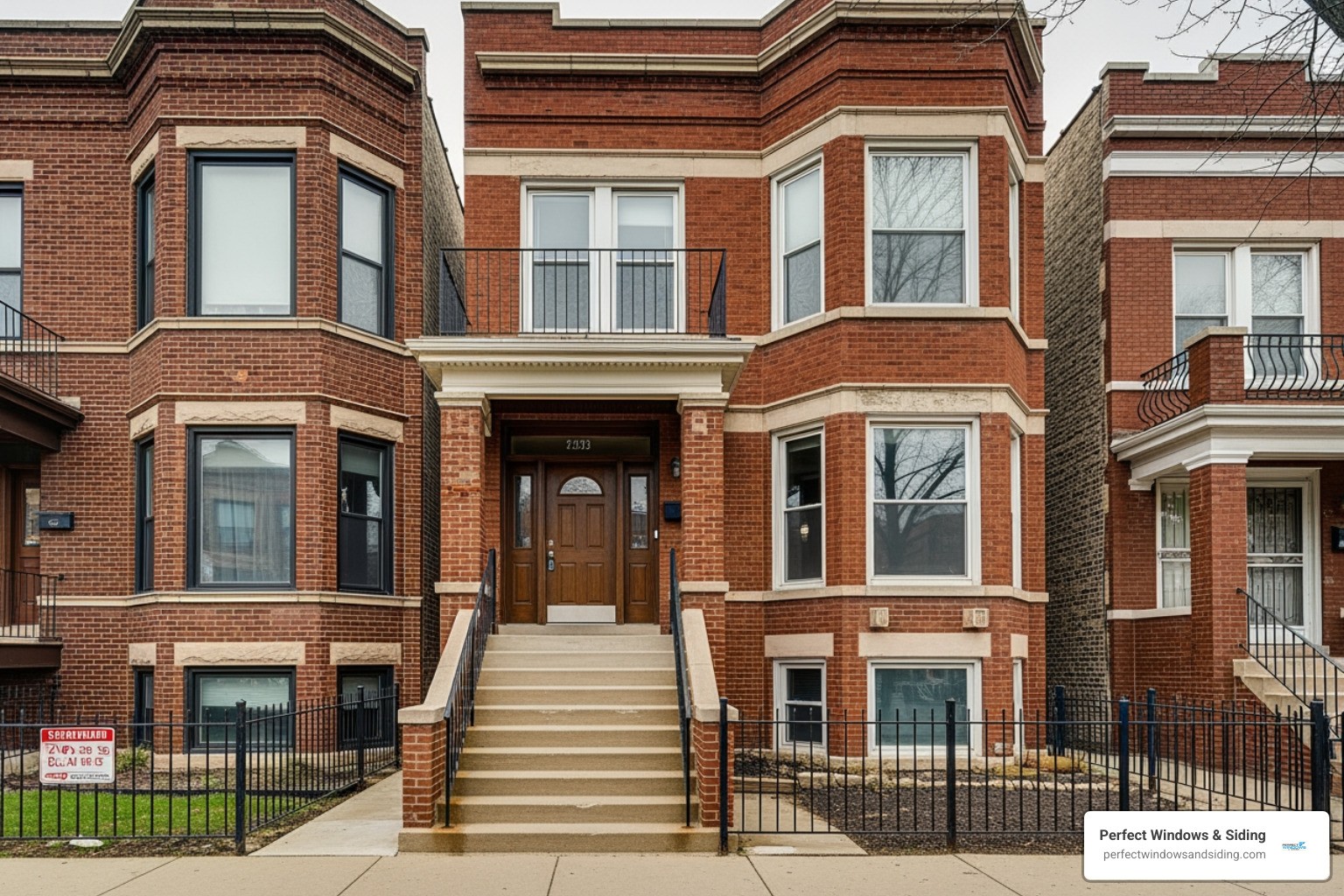
Why Some Chicago Homes Have a Front Door on the Second Floor
If you’ve ever walked through Bridgeport or Pilsen and noticed a front door that’s one full flight of stairs above the sidewalk, you’ve spotted one of Chicago’s most fascinating architectural quirks. A chicago entry door second floor setup isn’t a design choice — it’s a survival story baked into the city’s history.
Here’s the short answer:
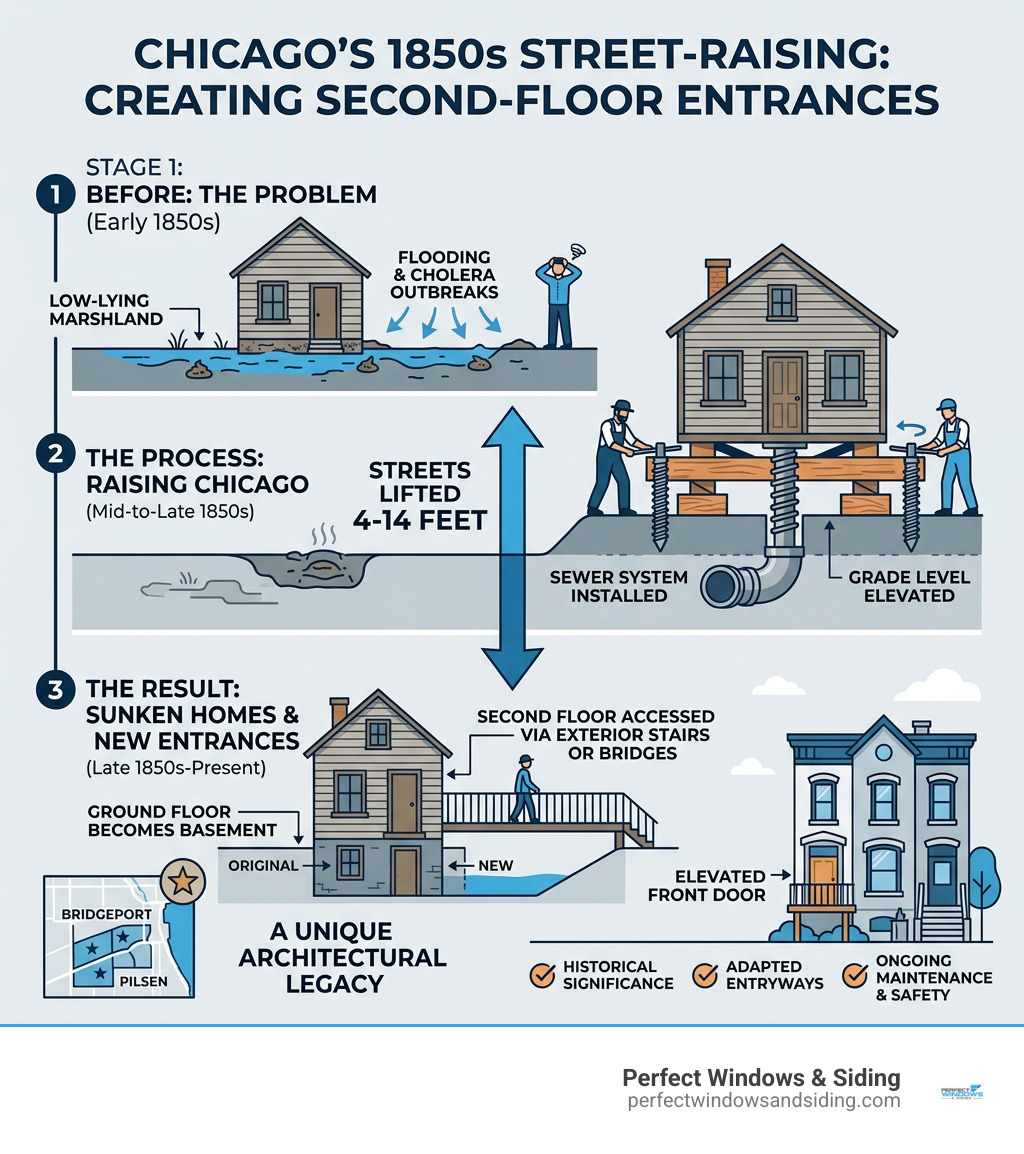
- In the 1850s, Chicago raised its streets 4 to 14 feet to install a sewer system and fight deadly cholera outbreaks
- Buildings that weren’t lifted ended up sitting below the new street level — what locals call “sunken homes”
- Homeowners adapted by adding exterior stairs or bridge-like walkways to reach what was now the second-floor door
- These elevated entrances still exist today, especially in neighborhoods that survived the Great Chicago Fire of 1871
- Modern owners of these homes face real challenges: safety, weather exposure, building codes, and choosing the right door materials
One resident in Pilsen described her home’s entrance as a concrete slab that works almost like a drawbridge — you cross it just to get to the front door. It’s charming, but it comes with real responsibilities.
I’m Voytek Glab, owner of Perfect Windows & Siding, and over my 20+ years installing entry doors across Chicagoland, I’ve worked on dozens of homes with a chicago entry door second floor setup — each one with its own structural quirks and safety needs. Let me walk you through what you need to know before making any changes to yours.
Chicago entry door second floor glossary:
- door replacement Elk Grove Village
- energy efficient door installation
- front door replacement chicago il
The History of the Chicago Entry Door Second Floor Phenomenon
To understand why you might be standing on a bridge to ring a doorbell, we have to look back at the 1850s. At that time, Chicago was essentially a swamp. The city was built on low-lying, marshy land near Lake Michigan, and the mud was so thick that horses were known to get stuck in the middle of the street.
Worse than the mud was the sewage. Because the ground was so flat and low, there was nowhere for waste to go. This lack of drainage led to horrific public health crises, including major cholera outbreaks that claimed thousands of lives. The city leaders realized that if Chicago was going to survive and grow, it had to get out of the muck.
The Great Street Raising
Starting in 1855, the city embarked on a massive engineering project: they decided to raise the entire city. Over the next 20 years, roads were elevated anywhere from 4 to 14 feet. To do this, workers built new brick sewers on top of the existing ground and then piled dirt over them to create new, higher street levels.
This left property owners with a difficult choice:
- Raise the building: Using hundreds of jack screws and a small army of men, entire buildings were lifted inch by inch to meet the new street level. In January 1858, the first building was successfully raised, and eventually, as many as 50 massive downtown buildings were hoisted up.
- Leave it “sunken”: Many homeowners, particularly in working-class neighborhoods, couldn’t afford the expensive lifting process. Their homes stayed exactly where they were, but the world around them moved up. Suddenly, their front yards were 10 feet below the sidewalk, and their original front doors were staring at a wall of dirt.
You can read more about this incredible feat in this Raising Chicago illustrated history or explore Chicago’s ‘sunken’ homes history to see how these remnants still define our city’s landscape.
Adapting to the New Street Level
For the “sunken” homes, the original first floor became a garden-level basement. To get inside from the new, higher street, residents had to get creative. This is where the chicago entry door second floor was born.
Homeowners began installing exterior staircases leading from the new sidewalk down to the original door, or more commonly, they converted a second-story window into a new front door. To reach this new entrance, they built wooden or concrete bridges spanning the gap between the sidewalk and the house. This also led to the creation of “vaulted sidewalks”—hollow spaces under the concrete where people stored coal or even built outhouses.
If you are currently living in one of these historic gems and need a new entrance that honors this history while providing modern security, check out our guide on Exterior Door Installation Chicago.
Neighborhoods Famous for Sunken Homes and Elevated Entrances
While the street-raising happened across the city, the best places to see a chicago entry door second floor today are the neighborhoods that were spared by the Great Chicago Fire of 1871. Because the fire leveled much of the downtown and north side, many of the original sunken structures there were lost.
However, neighborhoods like Bridgeport and Pilsen remained largely intact. In these areas, you’ll find blocks of “workers cottages”—narrow, gable-front homes typically built on 25-foot-wide city lots. These cottages were the backbone of Chicago’s housing for the working class from the 1870s to the 1910s.
In Bridgeport, the phenomenon is so common that locals sometimes joke the neighborhood was named because you have to cross a “bridge” just to get into your house. In Pilsen, the contrast is even more striking, with beautifully maintained brick cottages featuring ornate metal railings and concrete “drawbridges” leading to an elevated second-floor entry.
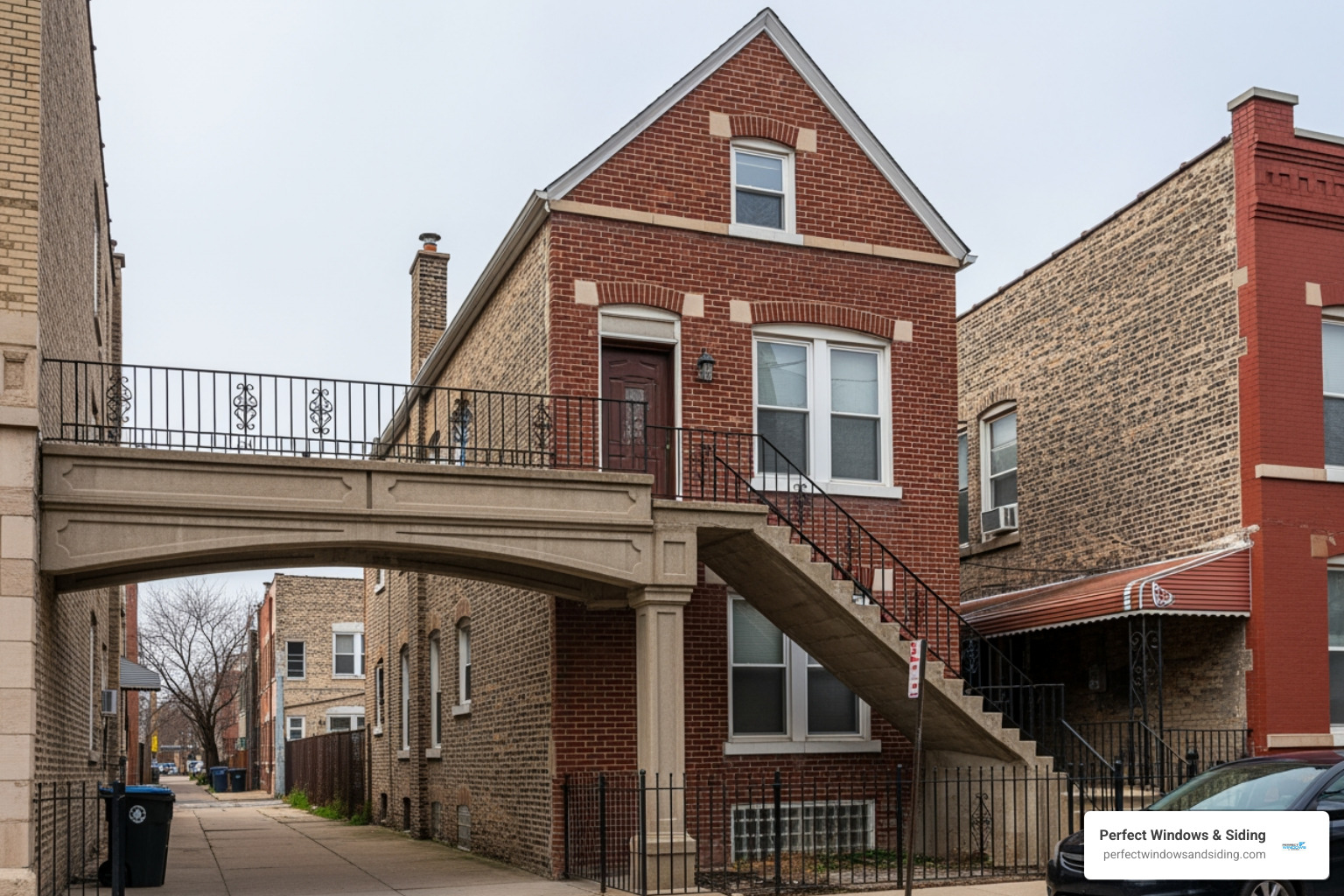
For those interested in the architectural specifics of these homes, the Workers cottage identification and history provides a deep dive into how these 1-1/2 story homes evolved over time.
Safety and Structural Requirements for a Chicago Entry Door Second Floor
When your front door is 10 feet in the air, you can’t just slap a new door in the frame and call it a day. There are significant safety and structural considerations that we always discuss with our clients at Perfect Windows & Siding.
- Landing Requirements: According to modern building codes, you generally cannot have a door swing directly over a set of stairs. You need a landing that is at least as wide as the door itself.
- Railing Safety: These aren’t just decorative. Railings must be structurally sound and meet height requirements to prevent falls. We’ve seen cases where old wooden railings have rotted from the inside out, creating a massive liability.
- Structural Integrity of the Bridge: Whether your entrance is a concrete slab or a wooden deck, it is a structural element. It must be able to support the weight of multiple people, heavy furniture during a move, and the weight of Chicago’s infamous snow piles.
- Door Swing and Clearance: On an elevated entry, the direction the door swings matters. Most entry doors swing inward, but you must ensure there is enough room on the interior landing so you aren’t backing up onto the bridge just to let a guest in.
For a deeper look at the technical side of these installations, our Entry Door Installation Chicago Complete Guide covers everything from framing to finishing.
Modern Challenges and Material Selection for Elevated Doors
Living with a chicago entry door second floor means your entrance is more exposed to the elements than a standard ground-level door. Wind, rain, and snow hit elevated doors with more force because they lack the protection of surrounding structures or dense landscaping.
Choosing the Right Material
In our 20+ years of experience in Chicagoland, we’ve found that material choice is the most critical factor for an elevated door’s longevity.
- Fiberglass: This is often our top recommendation. Fiberglass doors can be manufactured with a Custom Wood Exterior Doors look but without the maintenance. They won’t warp, rot, or rust, which is vital when the door is perched on a bridge exposed to Lake Michigan winds.
- Steel: For maximum security, Custom Steel Residential Doors are an excellent choice. Modern steel doors are highly insulated and can handle the structural stresses of an elevated frame.
- Wood: While beautiful, Custom Solid Wood Exterior Doors require the most maintenance. On a second-floor entry, you’ll need to be diligent about staining and sealing to prevent the wood from “checking” or cracking due to sun and moisture exposure.
Comparison Table: Door Materials for Elevated Entries
| Feature | Fiberglass | Steel | Wood |
|---|---|---|---|
| Durability | Excellent | High | Moderate |
| Maintenance | Low | Low | High |
| Insulation (R-Value) | Highest | High | Moderate |
| Security | High | Highest | High |
| Aesthetics | Wood-mimicking | Modern/Clean | Authentic/Classic |
Customizing Your Chicago Entry Door Second Floor for Curb Appeal
Just because your door is elevated doesn’t mean it can’t be a showstopper. In fact, an elevated entry is often the first thing people notice about a sunken home.
- Sidelites and Transoms: If you have the space, adding Custom Entry Doors with Sidelights can flood your interior hallway with light. However, ensure the framing is reinforced, as the “bridge” entrance can sometimes vibrate more than a ground-level foundation.
- Modern Colors: We’ve seen a trend in neighborhoods like Logan Square and Pilsen where homeowners use vibrant colors—like deep navy or forest green—to make their Custom Entry Doors Chicago pop against historic brick.
- Hardware: Choose high-quality, weather-resistant hardware. On a second floor, you want a lockset that won’t freeze up in February.
Frequently Asked Questions about Chicago’s Second Story Doors
Why are some Chicago front doors below street level?
These are “sunken homes.” They sit at the original 19th-century ground level. When the city raised the streets by up to 14 feet in the 1850s to install sewers, these homeowners chose not to (or couldn’t afford to) jack up their houses to the new height.
Is the “coffin door” theory real?
You might have heard that the second door on old houses was a “funeral door” or “coffin door” meant for carrying out caskets. While it’s a spooky bit of folklore, it’s mostly an urban legend. Most historians agree that multiple doors were usually for ventilation, symmetry, or to allow homeowners to rent out rooms to boarders without them walking through the main living area.
Can I replace a second-floor entry door with a modern one?
Absolutely! In fact, it’s one of the best ways to improve your home’s energy efficiency. Because these doors are so exposed, a New Entry Door with modern weatherstripping and a high R-value can significantly lower your heating bills. Just make sure you work with a pro who understands the structural needs of an elevated entrance.
Conclusion
The chicago entry door second floor is more than just a quirky way to enter a house; it’s a living piece of Chicago’s “I Will” spirit. It represents a time when the city literally pulled itself out of the mud to become a world-class metropolis.
Whether you’re looking to preserve the historic charm of a workers cottage in Bridgeport or you want to upgrade your Pilsen home with a Custom Made Entry Doors Near Me solution, we are here to help. At Perfect Windows & Siding, we specialize in navigating the unique architectural challenges of Chicago homes. We offer custom solutions, a lifetime warranty, and the personalized service you expect from a local, family-owned business.
Don’t leave your home’s safety and curb appeal to chance. If your second-story entrance needs a refresh, Exterior Door Replacement is just a phone call away. Let’s make sure your “step into the air” is a step onto a solid, beautiful landing.
Ready to upgrade your historic Chicago entry? Explore our options for Custom Entry Doors Residential or find Entry Doors Installed Near Me by visiting our Door Replacement Chicago page today!