

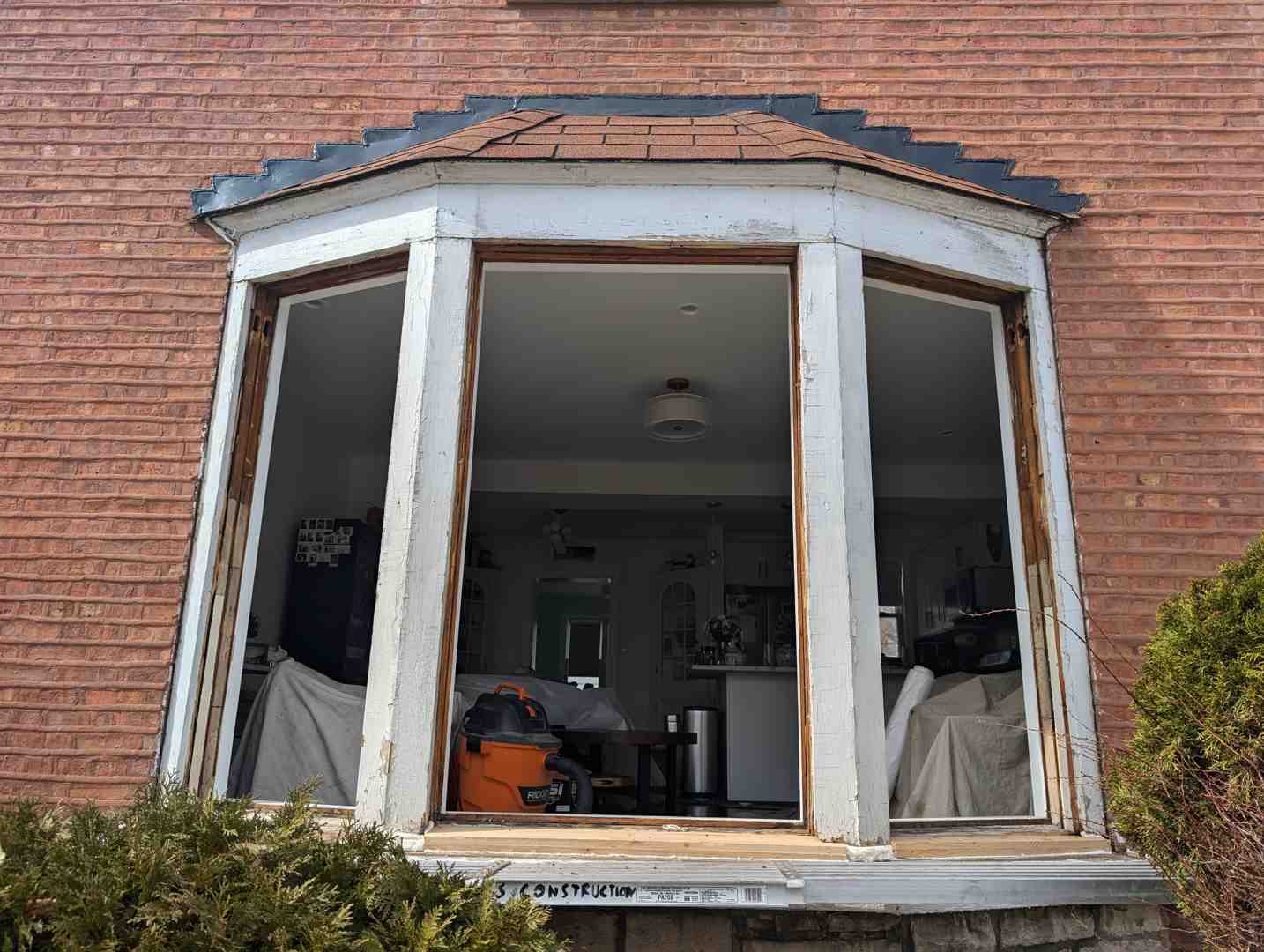
What does a bay window section detail show?
A bay window section detail shows how the projecting window is supported, insulated and connected to the wall and roof, including the flashing and drainage path. Dimensions, supports and rough-opening details depend on the selected window and the building. Use the product drawings and an assessment of the existing structure rather than treating example dimensions as a construction specification.
Why Every Homeowner Should Understand Bay Window Section Detail
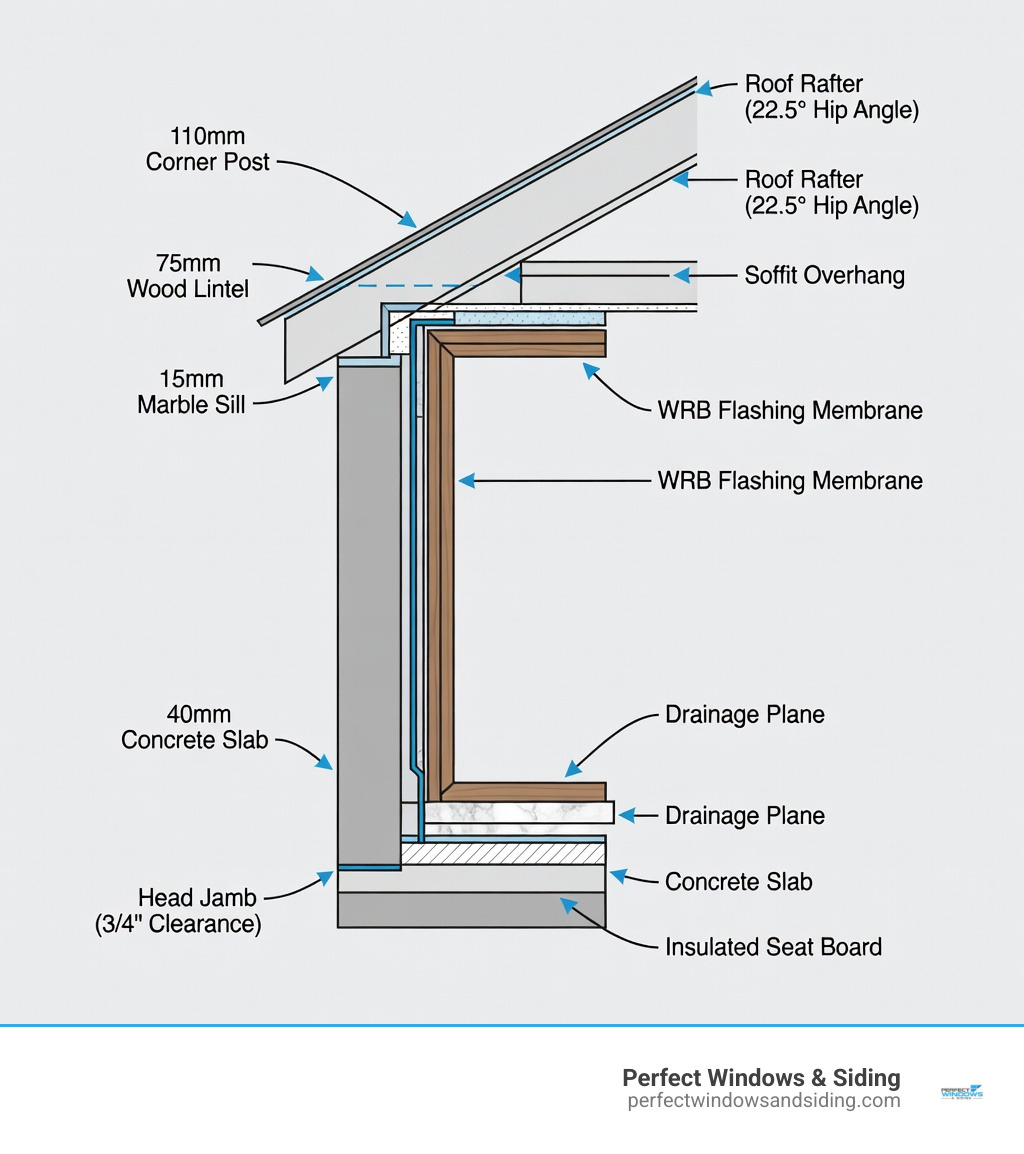
A bay window section detail is the technical cross-section drawing that shows exactly how a bay window is built — layer by layer, from the structural frame to the finished interior trim.
Here’s what a bay window section detail typically includes:
- Corner posts — usually 110mm wide for structural stability
- Head jamb — top of the frame, requiring ~3/4 inch clearance for panning systems
- Sill/seat board — insulated base that supports the window unit
- Wood lintel — typically 75mm, spanning the opening above
- Marble or stone sill — often 15mm thick at the interior base
- Concrete slab — around 40mm, part of the structural floor or seat
- Roof framing — rafters, sheathing, and soffit that protect the projection
- Flashing layers — WRB, self-adhesive membranes, and drainage planes that keep water out
Bay windows project outward from your home’s exterior wall at angles — most commonly 30° or 45°. That projection looks beautiful, but it creates real structural and weatherproofing challenges that a flat window simply doesn’t have.
Get the section detail wrong, and you’re looking at water intrusion, sagging floors, or a drafty room. Get it right, and you’ve added natural light, extra space, and serious curb appeal to your Chicago home.
I’m Voytek Glab, owner of Perfect Windows & Siding, and after 20 years of hands-on window installation across the Chicagoland area, I’ve seen every variation of bay window section detail — from simple vinyl replacements to complex masonry integrations. In this guide, I’ll walk you through everything you need to know to get it done right.
Bay window section detail terms you need:
Anatomy of a Bay Window Section Detail
When we look at a technical Bay Window Details drawing, we aren’t just looking at glass and wood. We are looking at a complex assembly designed to defy gravity and weather. Because a bay window hangs out past your foundation, every millimeter matters for its longevity.
In a high-quality bay window section detail, structural stability starts with the 110mm corner posts. These are the “bones” of the unit that join the center picture window to the angled “flanker” windows. Above the opening, a 75mm wood lintel (or header) must be properly sized to carry the wall load above the window.
Inside the home, the “floor” of the window is often finished with a 15mm marble sill for durability and aesthetics, resting on a 40mm concrete slab or a thick plywood insulated seat board. These components ensure the window doesn’t just look like an afterthought but feels like a solid extension of the house.
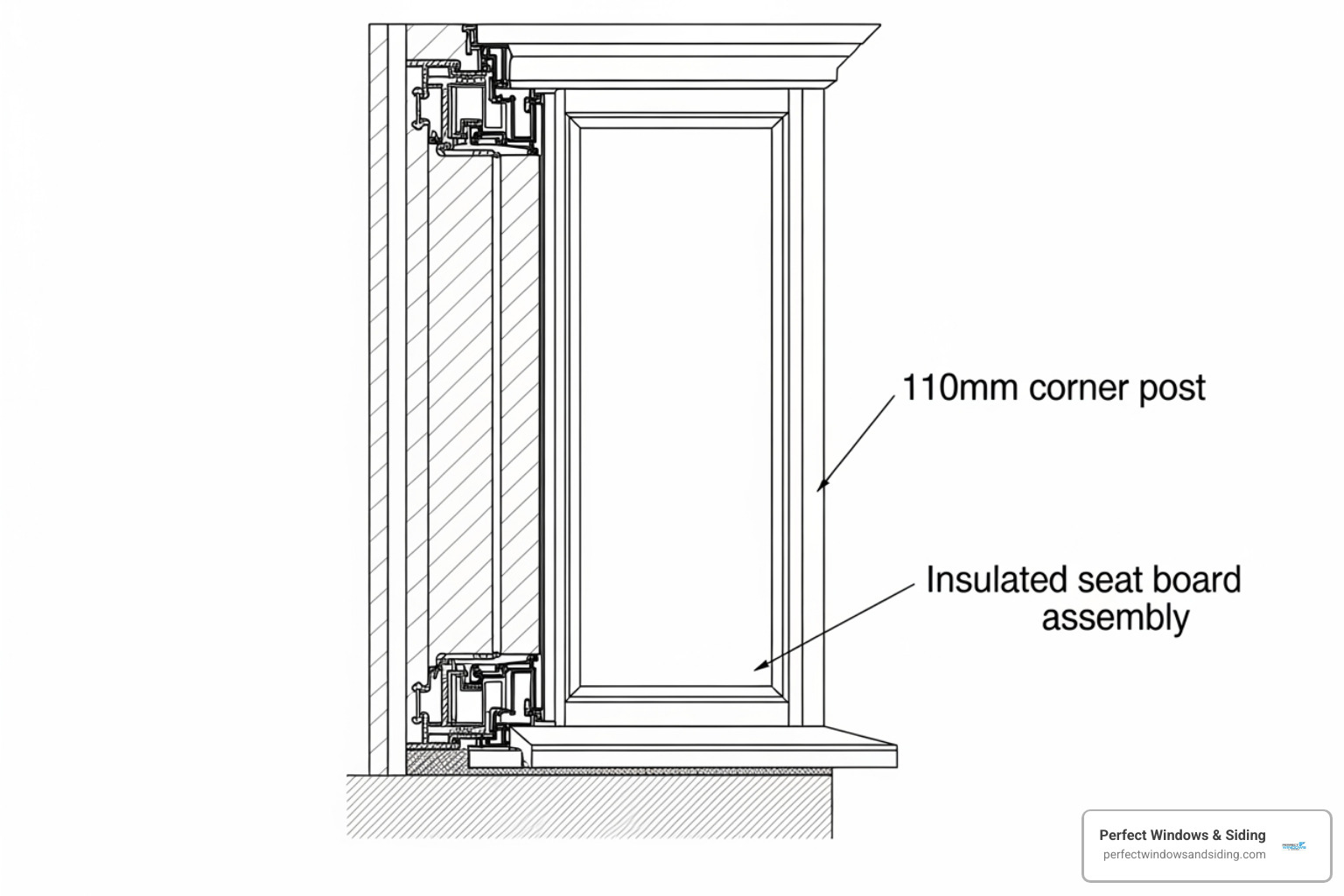
Understanding the Sill and Head Section Detail
The most critical points for water management are the head (top) and the sill (bottom). In our experience across Chicagoland, from Park Ridge to Skokie, these are the areas where DIY installs often fail.
- The Head Jamb: You need a roughly 3/4-inch (19mm) clearance at the head jamb. This isn’t wasted space; it’s necessary to accommodate sill panning systems and allow for the slight natural settling of the house without crushing the window frame.
- The Sill Panning and Drip Caps: A proper bay window section detail includes a drip cap at the very top to shed water away from the unit. Below the window, a panning system acts as a secondary defense, catching any moisture that might sneak past the primary seals and directing it back out to the exterior drainage plane.
- Thermal Breaks and Back Dams: To keep Chicago’s winter chill out, we use back dams (a raised edge at the back of the sill pan) and thermal breaks within the frame to prevent heat from escaping. You can learn more about these critical components in our Window Installation Guide 2025.
Material Impact on the Bay Window Section Detail
The materials you choose change the “anatomy” of the section detail.
- Clad-Wood: These offer the beauty of wood inside with a protective aluminum shell outside. The section detail here focuses on the “mullion” strength where the wood pieces meet.
- Vinyl Frames: Popular for their efficiency and lower maintenance, vinyl sections often feature multi-chambered profiles that act as built-in insulation.
- Masonry Integration: If you’re installing into a brick veneer or concrete block wall, the detail must include specific “weep holes” and masonry ties to ensure the window doesn’t trap moisture against the wood framing.
For a deeper dive into how these materials stack up, check out this guide to wooden frames and vinyl frames.
Structural Support and Framing Requirements
Because a bay window projects into the world, it needs help staying up. It is not designed to support the weight of your home’s roof; in fact, it needs the home to support it.
| Feature | 30° Bay Window | 45° Bay Window |
|---|---|---|
| Common Projection | Shorter (approx. 12″-18″) | Deeper (approx. 18″-24″) |
| Interior Space | Moderate expansion | Maximum expansion/seating |
| Hip Rafter Angle | 15° | 22.5° |
| Visual Impact | Subtle, traditional | Bold, architectural |
For any projection over a certain depth, standard framing isn’t enough. We often employ a support cable system. These cables are anchored to the structural house framing (like the top plate or headers) and must be capable of supporting 1,300 lbs per cable. This prevents the “sag” that often plagues older bay windows. In some cases, especially on the first floor, we use knee braces—decorative but functional wooden brackets that transfer the weight back to the wall studs.
The Guidelines for Bay Windows emphasize that the rough opening (RO) must be perfectly square and level. We use plastic shims to achieve this, ensuring a minimum of 3/8-inch clearance above the sill plate for proper leveling.
Integrating the Roof into the Bay Window Section Detail
Building the roof is often the most intimidating part of a bay window section detail. Many pros actually build the roof on the ground first using a template made from the window’s own shape.
- Pitch and Geometry: A common choice is a 12-in-12 pitch. For a standard 45° bay, the hip rafters require a 22.5° bevel to properly bisect the window’s corners. This follows octagonal geometry.
- The Rafter Nailer: We create a “nailer” that mimics the window’s footprint. This allows us to set the common, hip, and jack rafters with precision before lifting the entire assembly into place.
- Overhangs: A typical soffit overhang adds about 4-1/2 inches to the roof framing. This provides a finished look and protects the window head from direct rain.
For a visual of how a roof transforms the look of a home, see our gallery on adding a bay window before and after.
Considering a bay window for your Chicagoland home? Explore our installation services and discuss the requirements for your project.
Explore Bay Window InstallationWeatherproofing and Flashing Techniques
In the Chicagoland climate, from the windy lakefront of Evanston to the suburbs of Arlington Heights, weatherproofing is non-negotiable. A bay window section detail is only as good as its flashing.
- WRB Integration: The Weather Resistive Barrier (house wrap) must be integrated with the window’s flashing. The top flashing goes under the WRB, while the side and bottom flashing go over it to create a “shingle” effect that sheds water.
- Primary vs. Secondary Seals: The primary seal is the caulk you see on the outside. The secondary seal is the hidden flashing and tape that catches what the caulk misses.
- Backer Rods and Foam: If a gap is wider than 1/4 inch, we use a backer rod before applying sealant. We fill the internal cavities with minimal expansion foam to provide a thermal barrier without bowing the window frame.
For more on the specific codes and techniques we use locally, refer to our Window Installation Illinois Complete Guide.
Specialized Details for High-Performance Walls
Modern construction often requires even more specific detailing.
- Passivhaus: These details focus on extreme airtightness, using specialized membranes and tapes at every junction to ensure zero drafts.
- Brick Veneer and Stucco: These walls require a “drainage plane”—a small gap between the siding and the window frame that allows moisture to escape through weep holes.
- Oriel Windows: Unlike a standard bay that might have a “skirt” or foundation, an oriel window is a bay that is supported by corbels or brackets on an upper floor. The section detail here must account for the transition between the cantilevered base and the wall.
You can explore these architectural nuances in our Custom Window Design Complete Guide.
Common Installation Mistakes to Avoid
In our 20+ years at Perfect Windows & Siding, we’ve been called in to fix many “handyman specials.” Here are the most common errors found in a poorly executed bay window section detail:
- Inadequate Support: Failing to use support cables or knee braces leads to the window pulling away from the house, creating huge gaps at the top.
- Blocked Drainage: Shoving insulation into the weep holes or drainage planes traps water, leading to rot in the wall studs.
- Incorrect RO Height: If the rough opening is too tight, there’s no room for the sill pan or for the window to be leveled properly.
- Over-tightening Cables: This can actually bow the head board upward, making the window difficult to operate.
- Misaligned Flankers: If the side windows (flankers) aren’t at the exact same angle, the roof will never sit right, and the unit will look “crooked” from the street.
Before you start, make sure you know How to Measure a Window for Replacement to avoid ordering a unit that won’t fit your structural headers.
Frequently Asked Questions about Bay Window Construction
What is the difference between a bay and a bow window?
A bay window typically has three openings: a large center picture window flanked by two smaller windows (usually casement or double-hung) at 30° or 45° angles. A bow window uses four, five, or six windows of the same size to create a gentle, curved arc. Bay windows are more angular and modern, while bow windows offer a Victorian, “rounded” look.
How do you support a bay window without a foundation?
Most residential bay windows are “floating.” They are supported by a combination of a heavy-duty header above the opening and either a support cable system (which pulls the window up toward the house’s top plate) or knee braces (brackets underneath that push the weight back into the wall).
What are the standard angles for bay window sections?
The two most common angles are 30° and 45°. A 30° bay projects less and is great for tighter spaces or walkways. A 45° bay projects further out, creating a deeper interior “nook” that is perfect for a window seat. Some “box bays” even use a 90° angle for a modern, rectangular look.
Conclusion
Mastering the bay window section detail is about more than just following a blueprint; it’s about understanding how a home breathes, moves, and stands up to the elements. Whether you are in Naperville, Des Plaines, or right in the heart of Chicago, your bay window is a major structural component that demands precision.
At Perfect Windows & Siding, we pride ourselves on being a local, family-owned business that treats every installation like it’s for our own home. We don’t just “pop in” a window; we ensure the structural integrity, thermal efficiency, and aesthetic beauty of your home are protected for a lifetime. In fact, our commitment to quality is backed by a lifetime warranty.
If you’re ready to transform your home with a professionally installed bay window, we’re here to help. From the initial custom design to the final flashing detail, our team has the experience to do it right the first time.
Ready to see the difference a perfect view can make? Explore our services for Bay Window Park Ridge and let’s start your project today!
Explore Bay Window InstallationSources and next steps
Andersen window installation and support documents. Select the guide for the exact bay window series. This is a manufacturer example, not a specification for every bay window.
Related reading: See the Light: Bay Window Before and After Inspiration.
For help with a Chicago-area project, explore our bay window installation in Park Ridge.