

Siding Repair and Upgrades in Chicago
Perfect Windows & Siding
Let’s Work Together!
Perfect Windows & Siding
Let’s Work Together!
Siding damage in Chicago follows predictable patterns. Freeze-thaw cycling cracks vinyl panels and lifts seams. Sustained moisture infiltration through failed caulking rots sheathing behind panels that still appear intact from the street. Hail dents and splits surfaces across specific elevations while the rest of the exterior remains undamaged. UV exposure fades and chalks finishes across every material type over a long enough service life. The damage mechanisms are consistent. What varies is whether the correct response is repair, targeted upgrade, or full replacement — and that determination requires an on-site assessment of conditions that are not visible from the exterior alone.
We provide siding repair and upgrade services throughout Chicago and the surrounding suburbs. We have been working on Chicago’s residential exterior stock for over 20 years. We give honest repair versus replace recommendations — not default replacement upsells when repair is the correct answer, and not deferred replacement recommendations when repair is not going to hold.
This page covers siding repair and upgrades in Chicago in full — how to identify damage that warrants a contractor call, how to make the repair versus replace determination, how individual panel replacement works, what upgrades make sense for older Chicago homes, and how siding repairs affect energy efficiency. It is written for homeowners who are evaluating a specific condition on their home and need accurate information before they decide how to proceed.
Free on-site assessments are available. Call us to schedule yours.
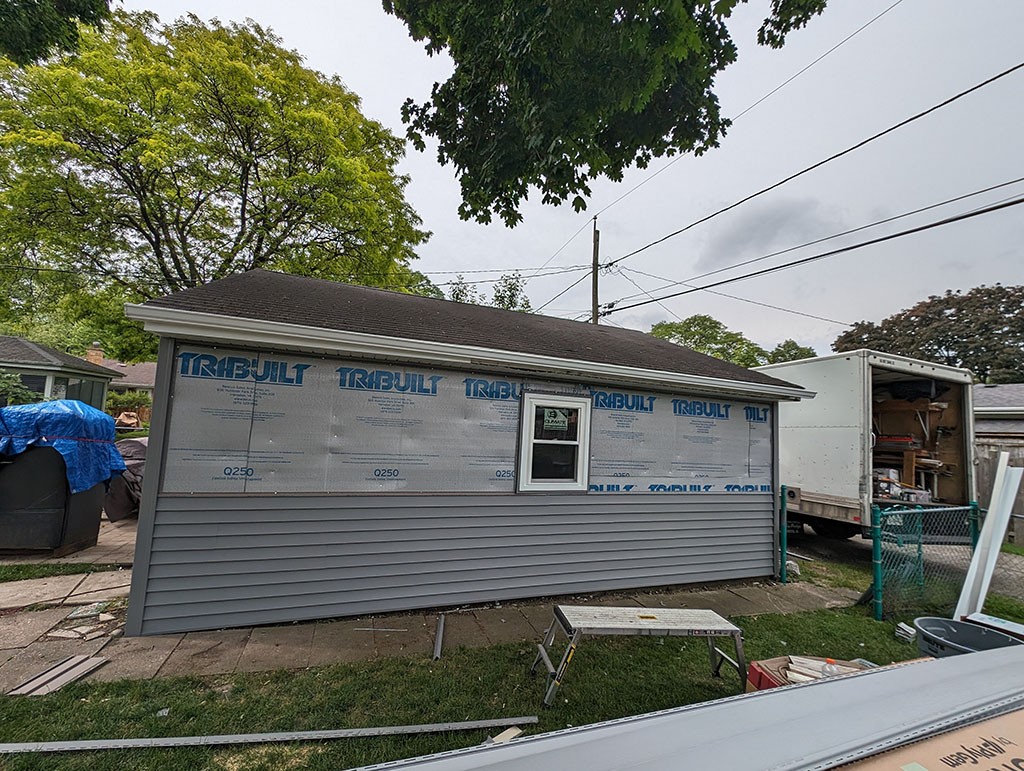
The distinction between siding that looks worn and siding that is failing as a weather barrier is not always visible from the street. Some of the most consequential siding failures in Chicago’s climate are invisible from the exterior until the damage behind them has progressed to a point where repair scope and cost are significantly larger than they would have been at earlier detection.
The following conditions indicate that siding repair warrants a contractor assessment — not deferred monitoring.
Cracked, split, or broken panels Any panel with a crack, split, or break that penetrates the full thickness of the panel has created an opening in the weather barrier. In Chicago’s climate, that opening is a water entry point in every rain event and a freeze-thaw stress point in every temperature cycle that crosses the freeze threshold. A crack that is small in October is typically larger by March — water that entered through the crack in fall freezes in winter and expands, widening the crack and potentially lifting adjacent panels. Cracked panels that have survived one Chicago winter without repair have almost certainly allowed water contact with the substrate behind them.
Buckled or warped panels Vinyl panels that are visibly buckled — bowing outward in a wave pattern — were typically installed without adequate thermal expansion allowance. The buckling itself is not a weather barrier failure, but it creates gaps at the J-channel and trim where the panel has pulled away from its correct position. Those gaps are air and water infiltration points. Warped fiber cement panels indicate moisture infiltration behind the panel that has affected the substrate — a condition that requires substrate inspection, not only surface repair.
Gaps at seams, corners, or perimeter trim Gaps at any location where two panels meet, where a panel meets a corner post, or where the siding meets window and door perimeter trim are direct air and water infiltration pathways. Window and door perimeter caulking that has cracked, shrunk, or separated from the adjacent surfaces is the most common water entry point in any Chicago siding system — and one of the most commonly deferred maintenance items. Failed caulking at a single window perimeter can allow water infiltration that reaches the rough framing around the window opening and causes rot that is not visible until the window itself begins to show operational problems.
Interior symptoms adjacent to exterior walls Peeling paint on interior walls adjacent to the exterior, soft drywall near window and door openings, musty smell in rooms with exterior wall exposure, and visible moisture staining on interior surfaces all indicate that water has already entered the wall assembly through the siding. By the time interior symptoms are visible, the moisture has typically been present in the wall for long enough to have caused meaningful substrate damage. These conditions warrant immediate assessment — not monitoring.
Fading, chalking, or severe discoloration Fading and chalking are cosmetic conditions, not structural failures — they do not indicate weather barrier failure on their own. However, severe chalking on aluminum siding indicates a paint condition that can no longer be restored by cleaning, and severely faded vinyl siding that has become brittle from UV degradation is more susceptible to cracking and impact damage than it was in its original condition. Cosmetic deterioration that has progressed to material brittleness is a precursor to structural failure in Chicago’s climate.
In Jefferson Park, Norwood Park, and the older northwest suburbs, mid-century siding is reaching or past end of life across entire blocks. Homeowners in those neighborhoods who have not had their siding assessed in the past five years should treat any visible deterioration as a signal to schedule an on-site assessment before Chicago’s next heating season creates conditions that accelerate whatever damage is already present.
The repair versus replace decision is the most consequential determination in any siding project. Making it incorrectly in either direction produces a bad outcome — unnecessary replacement spend when repair would have held correctly, or repair spend on a siding system that fails within a few years because the underlying condition warranted replacement.
The determination cannot be made accurately from a phone conversation, from exterior photographs, or from street-level observation. It requires removing damaged panels, inspecting the substrate and moisture barrier behind them, assessing the overall condition of the existing siding, and evaluating whether matching replacement material is available. We make that determination during the on-site assessment — and we report what we find, not what produces the larger project.
Conditions that support repair
Repair is the correct answer when five conditions are simultaneously present.
First, the damage is isolated to a limited number of panels — a specific hail strike pattern on one elevation, a failed seam at one location, a cracked panel at one point — rather than distributed across multiple elevations and heights. Isolated damage indicates a specific event or failure point rather than systemic siding deterioration.
Second, the substrate behind the damaged panels is sound — the sheathing is dry and structurally intact, the moisture barrier is present and undamaged, and no rot or mold is present in the wall assembly at the repair location. A sound substrate means the panel damage has not yet produced secondary damage that enlarges the repair scope.
Third, the existing siding is within its expected service life. A vinyl siding installation that is eight years old and has localized hail damage is a repair candidate. The same installation at 35 years old, with hail damage on top of widespread fading and brittleness, is a replacement candidate — the hail damage is the visible event, but the siding’s overall condition means repair buys a short extension on a system that is approaching end of life regardless.
Fourth, matching replacement panels can be sourced. For vinyl siding, matching depends on the profile, color, and manufacturer of the existing installation. Current product lines from major manufacturers are matchable for recent installations. Older installations — particularly those from smaller regional manufacturers or discontinued product lines — may not have available matches. A repair with a visibly mismatched panel is an outcome that some homeowners accept and others do not; that preference should be established before the repair is scheduled.
Fifth, the rest of the exterior is in sound condition. Repairing damaged panels on a home where the surrounding siding is uniformly deteriorated extends the life of the specific repair while leaving the broader failure condition in place. Within a few years, the surrounding siding produces the same water infiltration and substrate damage at new locations that the repair addressed at the original location.
Conditions that support replacement
Replacement is the correct answer when any of the following conditions are present.
Damage is widespread across multiple elevations, heights, or panel courses. Widespread damage indicates systemic failure — either end-of-life material behavior or installation deficiencies that affect the full system — that repair cannot correct in aggregate.
The substrate shows moisture infiltration or rot. Substrate damage found during panel removal means water has been in the wall assembly long enough to cause secondary damage. The extent of substrate damage is not fully assessable until the panels are removed — but finding rot or significant moisture damage at one location increases the probability of finding it at adjacent locations. A repair that replaces panels without addressing substrate damage leaves moisture conditions in place that continue to degrade the wall assembly.
The existing siding is at end of life. Material that has reached the end of its service life — brittle vinyl, heavily oxidized aluminum, wood siding with widespread rot — will continue to fail at new locations after isolated repairs are completed. Repair extends specific failure points; it does not restore end-of-life material to serviceable condition.
Matching material is not available. Chicago’s mid-century aluminum siding stock presents this condition consistently — matching aluminum profiles from 1960s and 70s installations are increasingly difficult to source, and aluminum cannot be painted to match original factory finish. Repair is frequently not a viable outcome for aluminum siding damage, making replacement the practical default regardless of damage scope.
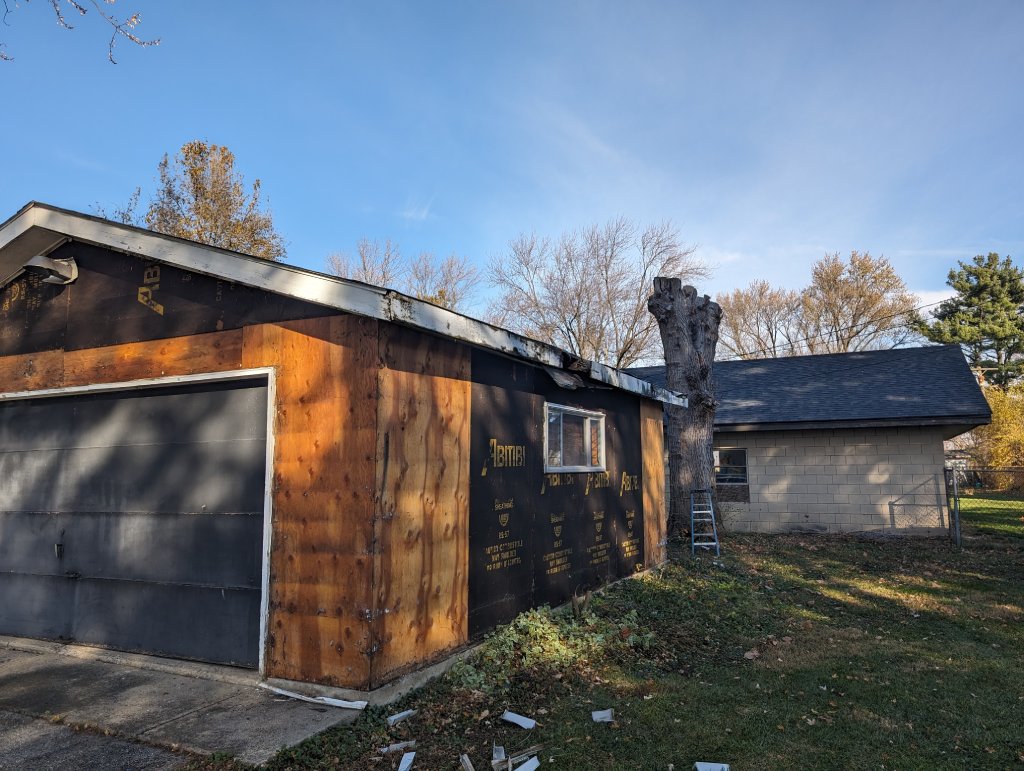
Individual panel replacement — removing and replacing a limited number of damaged panels without disturbing the surrounding installation — is the standard repair procedure for both vinyl and fiber cement siding in Chicago. The technical process differs between the two materials, and understanding that difference helps homeowners set accurate expectations before a repair is scheduled.
Vinyl panel replacement
Vinyl siding panels interlock with adjacent courses through a locking channel at the top of each panel that engages the bottom of the panel above it. Removing a damaged panel requires unlocking that engagement without damaging the panel above — a process that uses a zip tool to disengage the lock, allowing the damaged panel to be slid out and the replacement panel to be slid in and re-engaged.
This process is relatively straightforward for accessible damage locations — mid-wall panels on flat elevations. It is more involved for panels at corners, panels adjacent to window and door trim, or panels at the top course where the soffit or frieze board constrains access. In all cases, the replacement panel is nailed at the center of the nail slot with the correct thermal expansion allowance — the same installation standard as the original installation — and re-engaged with the panels above and below.
The critical step that is frequently omitted in incomplete repair work is the substrate and moisture barrier inspection that should accompany every panel removal. Removing a damaged panel provides access to the substrate and moisture barrier behind it — an access opportunity that does not otherwise exist without significant additional disruption. Inspecting the substrate at that access point confirms whether moisture has already entered and caused secondary damage, or whether the damage was caught before water infiltration occurred. A panel replacement that does not include substrate inspection addresses visible damage without confirming whether the repair is the full scope required.
Fiber cement panel replacement
Fiber cement panels are face-nailed rather than interlocked — each panel is fastened directly through its face into the framing or furring behind it, with nail heads that will be covered by paint. Removing a damaged fiber cement panel requires carefully extracting the face nails — using a nail puller rather than a pry bar to avoid damaging adjacent panels — and removing the panel without disturbing the substrate or moisture barrier behind it.
The replacement panel is cut to the same dimensions as the removed panel, all cut edges are sealed with fiber cement-compatible primer before installation, the panel is face-nailed to the framing at the specified nail spacing, and the nail heads and panel face are primed and painted to match the surrounding finish. The paint matching step is the variable that most affects the visible outcome of a fiber cement panel repair — a paint match that is close but not exact will be visible against the weathered surrounding panels, and the degree of visibility depends on how long the existing finish has been in place and how much it has weathered.
The hail damage scenario
Chicago hail events produce a specific panel replacement scenario that recurs across the residential market in the seasons following significant hail events. Hail strikes produce a characteristic damage pattern — concentrated on specific elevations and heights, with undamaged panels immediately adjacent to damaged ones — that is well-suited to individual panel replacement when the substrate is sound and matching material is available.
In Rogers Park, Avondale, and Chicago neighborhoods that experienced significant hail events in recent seasons, individual panel replacement has been the correct repair outcome for a large share of affected homes — the damage is isolated by elevation and the surrounding siding is in sound condition. The assessment question is always whether water entered through the damaged panels during the interval between the hail event and the repair, and whether that entry produced substrate damage that enlarges the repair scope beyond panel replacement alone.
Siding repair projects on older Chicago homes present an opportunity to address deficiencies in the original installation that repair alone does not correct. The following upgrades are appropriate to consider when panels are being removed for repair — the incremental scope required to add them at that point is significantly lower than it would be as standalone projects.
Insulated vinyl siding upgrade
For older Chicago homes where panels are being replaced due to damage or deterioration, upgrading from standard vinyl to insulated vinyl with EPS foam backing adds continuous R-value to the wall assembly at a scope increment that is modest relative to the panel replacement work already underway.
The energy efficiency benefit is most significant in homes where the wall cavity contains minimal or degraded original insulation — a condition common in Chicago’s older frame construction, particularly in neighborhoods like Pilsen, Ukrainian Village, and the Northwest Side where bungalows and two-flats were built before insulation requirements were part of the building code. For those homes, insulated vinyl is the only intervention that adds wall insulation without opening the wall cavity, and a repair project that requires panel removal is the most practical opportunity to make that upgrade.
Moisture barrier installation or replacement
Many older Chicago homes have no moisture barrier behind the original siding — panels go directly to the sheathing with no backup water management layer between them. When panels are removed for repair, installing house wrap before the replacement panels go on adds the moisture management layer that should have been there originally.
This upgrade is particularly important when the original siding panels have reached the stage of deterioration where small failures — failed caulking, minor cracks, lifted seams — are occurring at multiple locations. A moisture barrier behind the panels means that the individual failures that occur between repair cycles are not direct pathways for water to reach the sheathing. The upgrade does not replace the need to repair visible damage — but it significantly reduces the consequences of the small failures that occur between repair events.
Window and door perimeter trim and caulking upgrade
Window and door perimeter trim and caulking are the most common water entry points in any siding system and the most commonly deferred maintenance item in Chicago’s residential stock. Failed caulking at a window perimeter allows water infiltration that reaches the rough framing and causes rot that is not visible until the window shows operational problems — by which point the repair scope extends beyond caulking replacement to framing repair.
When siding panels adjacent to windows and doors are being removed for repair, replacing all perimeter trim and caulking at those openings as part of the same project addresses the infiltration pathway that is most likely to produce the next repair call. The incremental scope of the upgrade at that point — the trim is already accessible, the panels adjacent to it are already removed — is modest relative to the protection value it provides across the subsequent years.
Homeowners in Evanston, Winnetka, and Lincoln Square with older homes who have been deferring perimeter caulking maintenance should treat a repair project as the trigger point to address all accessible penetrations at once rather than on a piecemeal basis.
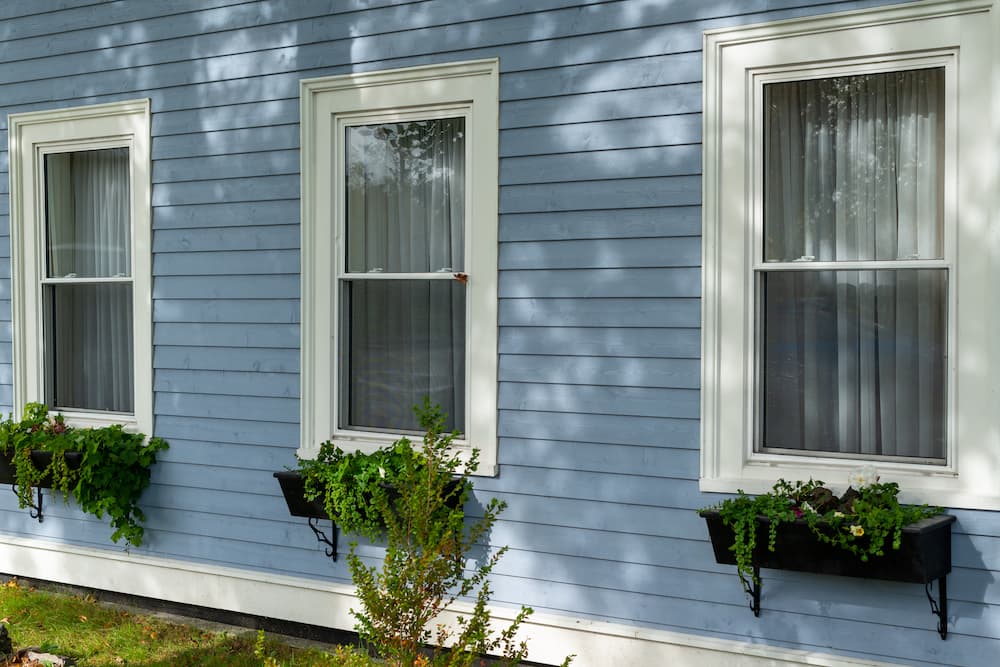
Siding repairs improve energy efficiency in Chicago homes through a specific and well-defined mechanism: eliminating the air infiltration pathways that exist at the failure points being repaired. Understanding the scope and limits of that mechanism helps homeowners set accurate expectations for the energy efficiency benefit of a repair project.
What repair addresses
Every gap, crack, failed seal, or lifted panel in a home’s siding system is an air infiltration pathway — a location where outdoor air can enter the wall assembly and conditioned indoor air can exit. In Chicago’s climate, those pathways impose energy cost continuously across the heating season. Air that moves through wall penetrations carries thermal energy with it — heated interior air escaping to the outside in winter and cold exterior air entering to replace it.
Siding repairs that seal those specific pathways eliminate the specific infiltration they created. A cracked panel that was allowing air infiltration at that location is no longer allowing it after replacement. Failed caulking at a window perimeter that was allowing air movement around the window rough opening is no longer allowing it after recaulking. The energy efficiency improvement from the repair is real, measurable over a full heating season, and present every day of that season — not only during extreme cold events.
In Chicago’s six-month heating season, repairs completed before the heating season begins provide the full energy benefit across the entire heating period. A repair completed in October provides six months of improved air sealing performance in the first heating season. A repair deferred until March provides two months of benefit before the heating season ends — the same repair, with four fewer months of energy efficiency return in year one.
What repair does not address
Siding repairs address air infiltration at the specific failure points repaired. They do not address the thermal resistance of the wall assembly as a whole. A home with adequate siding but minimal wall cavity insulation has a thermal performance limitation that siding repair cannot correct. The R-value of the wall assembly is determined by the insulation in the cavity and any continuous insulation layers — not by the siding condition. Correct siding seals the assembly against air infiltration; it does not substitute for insulation that is absent.
Homeowners who repair siding damage and then find that the home still has cold exterior walls and elevated heating costs should consider whether the remaining performance limitation is a wall insulation issue rather than a remaining siding failure. An on-site assessment can evaluate both conditions and identify whether the next intervention is additional siding work, insulation addition, or another element of the building envelope.
The repair-as-upgrade opportunity
When repair scope requires removing panels over a meaningful wall area, the exposed substrate presents an opportunity to add insulation or install a moisture barrier as part of the same project — the panel removal that was required for the repair provides access that would otherwise require additional disruption and cost. For older Chicago homes where wall insulation is minimal, this opportunity should be considered during the on-site assessment rather than after the repair panels are already back in place.
The most actionable indicators are cracked or split panels that penetrate the full panel thickness, gaps at window and door perimeter trim or panel seams, buckled panels that have pulled away from corner posts or J-channel, and interior symptoms — peeling paint, soft drywall, or moisture staining on walls adjacent to the exterior. In Chicago’s climate, damage that appears minor in fall typically worsens significantly through the freeze-thaw cycle — a small crack in October is often a significant substrate moisture problem by March.
Repair is correct when damage is isolated, the substrate is sound, the siding is within its service life, and matching panels are available. Replacement is correct when damage is widespread, the substrate has moisture damage, the siding is at end of life, or matching material cannot be sourced. An on-site assessment determines which condition applies — the determination cannot be made accurately without removing panels and inspecting the substrate and moisture barrier behind them.
Yes — vinyl panels can be unlocked and replaced individually without disturbing adjacent panels. Fiber cement panels can be extracted and replaced with cut edges sealed and paint matched. Both repairs should include substrate and moisture barrier inspection behind the removed panels — the access that panel removal provides is the only practical opportunity to confirm whether moisture has already entered the wall assembly at that location.
Individual panel replacements typically take two to four hours. Larger repair scopes — multiple panels, perimeter trim and caulking replacement, substrate repair — take one to two days. Projects that reveal substrate damage during panel removal extend the timeline by the repair time required for that damage. We provide a specific timeline during the on-site assessment based on the actual scope found.
For vinyl, matching depends on the age and profile of the existing installation — recent installations with current product lines match well; older installations may show color variation between new and weathered panels. Fiber cement repairs are painted on-site and achieve close color consistency that weathers toward the surrounding finish over time. Aluminum siding matching is increasingly difficult — limited panel availability frequently makes replacement the more practical outcome for aluminum damage.
We serve Chicago and the full Chicagoland area — including Des Plaines, Park Ridge, Morton Grove, Niles, Glenview, Winnetka, Naperville, Evanston, Hoffman Estates, and surrounding communities. Call us to schedule a free on-site assessment at your home.
Siding repair and upgrade decisions in Chicago require an on-site assessment before scope, approach, and correct outcome can be determined accurately. Panel condition, substrate integrity, moisture barrier status, material matching availability, and the overall condition of the surrounding siding all affect the correct recommendation — and none of those variables are assessable without removing panels and inspecting what is behind them.
📞 Call us today to schedule a free consultation today!
2026 Perfect Windows & Siding Powered by Wizerunek w Sieci - web development & SEO | Privacy | Accessibility | Terms and Conditions
This site is protected by reCAPTCHA and the Google Privacy Policy and Terms of Service apply.