

Exterior Home Improvements in Chicago
Perfect Windows & Siding
Let’s Work Together!
Perfect Windows & Siding
Let’s Work Together!
If you’re thinking about improving your home’s exterior in Chicago, you’re already ahead of the game. The exterior is the part of your home that works hardest — taking on every freeze-thaw cycle, every wind-driven rain event, every stretch of below-zero cold, and every hot humid summer that Chicago delivers year after year. When the exterior components are doing their job, you don’t think about them. When they start to fail, you feel it in your energy bills, your home’s appearance, and eventually your wallet.
We’re a local exterior remodeling company with over 20 years of experience in Chicago’s residential market. We handle windows, siding, and doors — the three components of a home’s exterior that have the most impact on comfort, appearance, energy efficiency, and property value. We work on everything from single-window replacements to full exterior renovations, and we treat every project with the same care whether it’s a one-day job or a two-week overhaul.
This page covers exterior home improvements in Chicago from the diagnostic question — how do you know what your home actually needs — through value, energy efficiency, property impact, and how improvements are customized for older Chicago homes. Find what applies to your situation, then give us a call. The estimate is free.
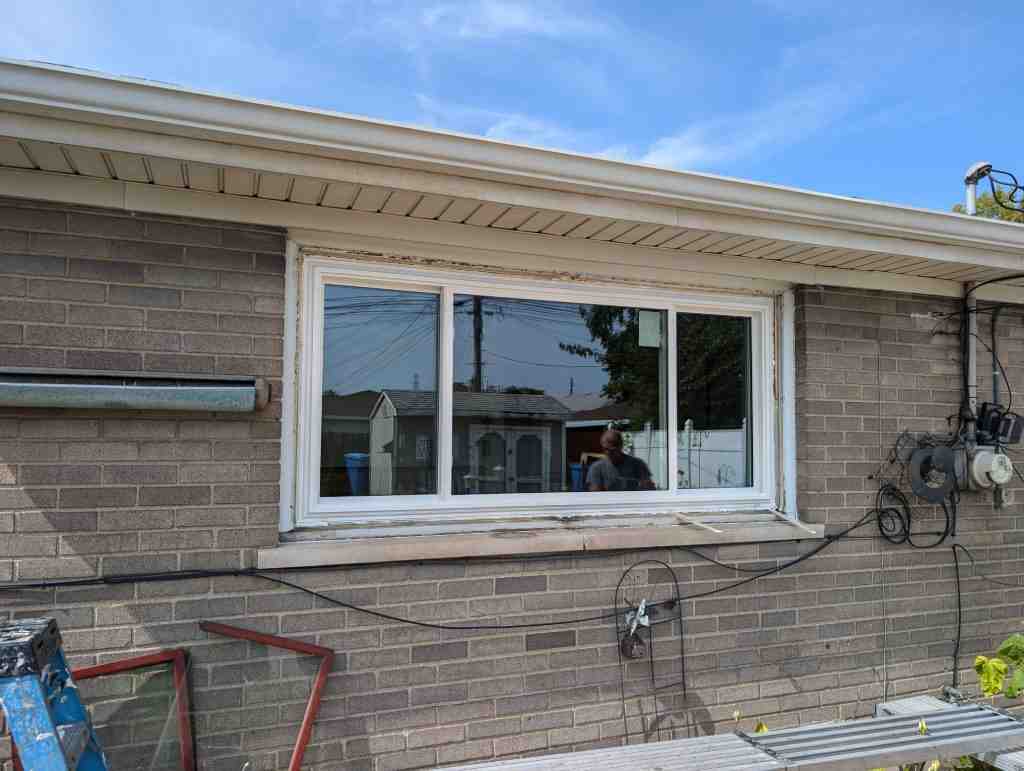
The most common call we get starts with something like: “I know the exterior needs work, but I’m not sure where to start.” That’s a completely reasonable place to be. Chicago’s exterior conditions can make it hard to know what’s cosmetic deterioration, what’s active failure, and what’s about to become a bigger problem.
The honest answer is that the correct starting point is an on-site assessment — not a phone conversation, not a self-diagnosis from the driveway, and definitely not a quote based on photographs. Here’s why that matters in Chicago specifically.
Chicago’s freeze-thaw cycle creates a category of damage that isn’t visible until you’re up close and looking for it. A window seal that appeared intact last spring may have failed through last winter’s cycling — the glass looks fine from the street, but the insulating gas fill is gone and the unit is performing like single-pane glass. Siding that looked worn but functional in October may have allowed moisture infiltration that became substrate damage by April. A door that closes fine in fall swells in summer humidity and gaps in winter cold — the seal failure isn’t obvious until you’re standing next to it with a candle on a windy day.
The on-site assessment we conduct during a free estimate covers all three trades in sequence.
Windows: We assess every window opening for seal condition — fogged glass or condensation between panes indicates a failed IGU. We check frame integrity for warping, racking, and signs of moisture infiltration at the sill. We test operability and weatherstripping contact. We note any single-pane glass still in place — in Chicago’s climate, that’s a thermal liability that no amount of weatherstripping correction resolves.
Siding: We walk every elevation for cracked, buckled, or lifted panels. We check window and door perimeter caulking — the most common water entry point in any siding system, and the most commonly deferred maintenance item in Chicago’s housing stock. Where siding condition suggests possible moisture behind the panels, we note it for the substrate assessment that occurs when panels are removed during installation.
Doors: We assess every exterior door for seal integrity, frame condition, and threshold performance. Hollow-core doors in frames that have been through 40 or 50 freeze-thaw cycles are the most common energy and security liability in Chicago’s older residential stock — visible from the outside but rarely assessed until a homeowner is standing in the doorway feeling cold air come in around the edges.
After the walkthrough, we give you a prioritized improvement scope — what needs immediate attention, what can be monitored, and what the project sequence should look like if you’re phasing the work over time. That scope is specific to your home, not a generic checklist that applies to any house anywhere.
The best timing for an exterior assessment in Chicago is late winter or early spring — after the freeze-thaw damage from the preceding winter is visible but before the improvement season gets busy. In neighborhoods like Rogers Park, Avondale, and the older Northwest Side where mid-century homes have been through decades of Chicago winters, early spring assessments consistently find more than homeowners expected going in.
If you’re thinking about improving your home’s exterior in Chicago, you’re already ahead of the game. The exterior is the part of your home that works hardest — taking on every freeze-thaw cycle, every wind-driven rain event, every stretch of below-zero cold, and every hot humid summer that Chicago delivers year after year. When the exterior components are doing their job, you don’t think about them. When they start to fail, you feel it in your energy bills, your home’s appearance, and eventually your wallet.
We’re a local exterior remodeling company with over 20 years of experience in Chicago’s residential market. We handle windows, siding, and doors — the three components of a home’s exterior that have the most impact on comfort, appearance, energy efficiency, and property value. We work on everything from single-window replacements to full exterior renovations, and we treat every project with the same care whether it’s a one-day job or a two-week overhaul.
This page covers exterior home improvements in Chicago from the diagnostic question — how do you know what your home actually needs — through value, energy efficiency, property impact, and how improvements are customized for older Chicago homes. Find what applies to your situation, then give us a call. The estimate is free.
The most common call we get starts with something like: “I know the exterior needs work, but I’m not sure where to start.” That’s a completely reasonable place to be. Chicago’s exterior conditions can make it hard to know what’s cosmetic deterioration, what’s active failure, and what’s about to become a bigger problem.
The honest answer is that the correct starting point is an on-site assessment — not a phone conversation, not a self-diagnosis from the driveway, and definitely not a quote based on photographs. Here’s why that matters in Chicago specifically.
Chicago’s freeze-thaw cycle creates a category of damage that isn’t visible until you’re up close and looking for it. A window seal that appeared intact last spring may have failed through last winter’s cycling — the glass looks fine from the street, but the insulating gas fill is gone and the unit is performing like single-pane glass. Siding that looked worn but functional in October may have allowed moisture infiltration that became substrate damage by April. A door that closes fine in fall swells in summer humidity and gaps in winter cold — the seal failure isn’t obvious until you’re standing next to it with a candle on a windy day.
The on-site assessment we conduct during a free estimate covers all three trades in sequence.
Windows: We assess every window opening for seal condition — fogged glass or condensation between panes indicates a failed IGU. We check frame integrity for warping, racking, and signs of moisture infiltration at the sill. We test operability and weatherstripping contact. We note any single-pane glass still in place — in Chicago’s climate, that’s a thermal liability that no amount of weatherstripping correction resolves.
Siding: We walk every elevation for cracked, buckled, or lifted panels. We check window and door perimeter caulking — the most common water entry point in any siding system, and the most commonly deferred maintenance item in Chicago’s housing stock. Where siding condition suggests possible moisture behind the panels, we note it for the substrate assessment that occurs when panels are removed during installation.
Doors: We assess every exterior door for seal integrity, frame condition, and threshold performance. Hollow-core doors in frames that have been through 40 or 50 freeze-thaw cycles are the most common energy and security liability in Chicago’s older residential stock — visible from the outside but rarely assessed until a homeowner is standing in the doorway feeling cold air come in around the edges.
After the walkthrough, we give you a prioritized improvement scope — what needs immediate attention, what can be monitored, and what the project sequence should look like if you’re phasing the work over time. That scope is specific to your home, not a generic checklist that applies to any house anywhere.
The best timing for an exterior assessment in Chicago is late winter or early spring — after the freeze-thaw damage from the preceding winter is visible but before the improvement season gets busy. In neighborhoods like Rogers Park, Avondale, and the older Northwest Side where mid-century homes have been through decades of Chicago winters, early spring assessments consistently find more than homeowners expected going in.
Not every exterior improvement delivers equal return. In Chicago’s residential market, three improvements consistently outperform the rest — and not just in national cost-vs-value analyses, but in the specific transaction data from Chicago-area homes where updated and original exteriors are compared side by side.
Window replacement
Window replacement is the only exterior improvement that delivers value through three channels simultaneously: thermal performance, curb appeal, and appraised condition rating. New windows with correct U-factor and Low-E specifications reduce heat loss, lower heating bills, and improve comfort in every room with an exterior window. They restore the visual appearance of the home’s exterior — clean, well-maintained windows read as a cared-for home from the street. And they improve the appraised condition rating that affects your home’s value relative to comparables.
That three-channel return is why window replacement consistently ranks among the highest return-on-investment exterior improvements in the data — and why it’s almost always the first improvement we recommend when a home’s exterior needs attention in multiple areas.
Siding replacement
Siding replacement delivers value primarily through two channels: weather protection restoration and buyer risk perception removal. Failing siding is visible from the street. Buyers and appraisers both notice it, and both respond to it — buyers with reduced offer amounts and increased inspection-driven negotiation leverage, appraisers with below-average condition ratings that pull the appraised value below what the home’s comparables otherwise support.
New siding removes those negative signals from the home’s presentation. It also restores the weather protection that failing siding was no longer providing — which is the more fundamental value, because weather protection failure that continues uncorrected produces substrate damage, rot, and eventually structural repair costs that dwarf the cost of the siding replacement that would have prevented them.
In Evanston, Park Ridge, and the northwest suburbs where comparable properties with updated exteriors are common, a home with original failing siding from the 1970s faces a competitive disadvantage in the transaction data. New siding closes that gap.
Entry door replacement
Entry door replacement delivers the highest curb appeal return per scope of work of any exterior improvement. The front door is the most visible single component of any home’s exterior — the focal point of the street-facing elevation, the first thing buyers and visitors see, and the component that sets the tone for the entire exterior presentation.
A worn, outdated, or visibly deteriorating front door creates a first impression that the rest of the exterior — regardless of condition — cannot entirely overcome. A new entry door, correctly specified for the home’s architectural style and installed with proper frame and seal, transforms that first impression immediately and produces a combination of curb appeal improvement, security upgrade, and insulation benefit that few other single-scope improvements can match.
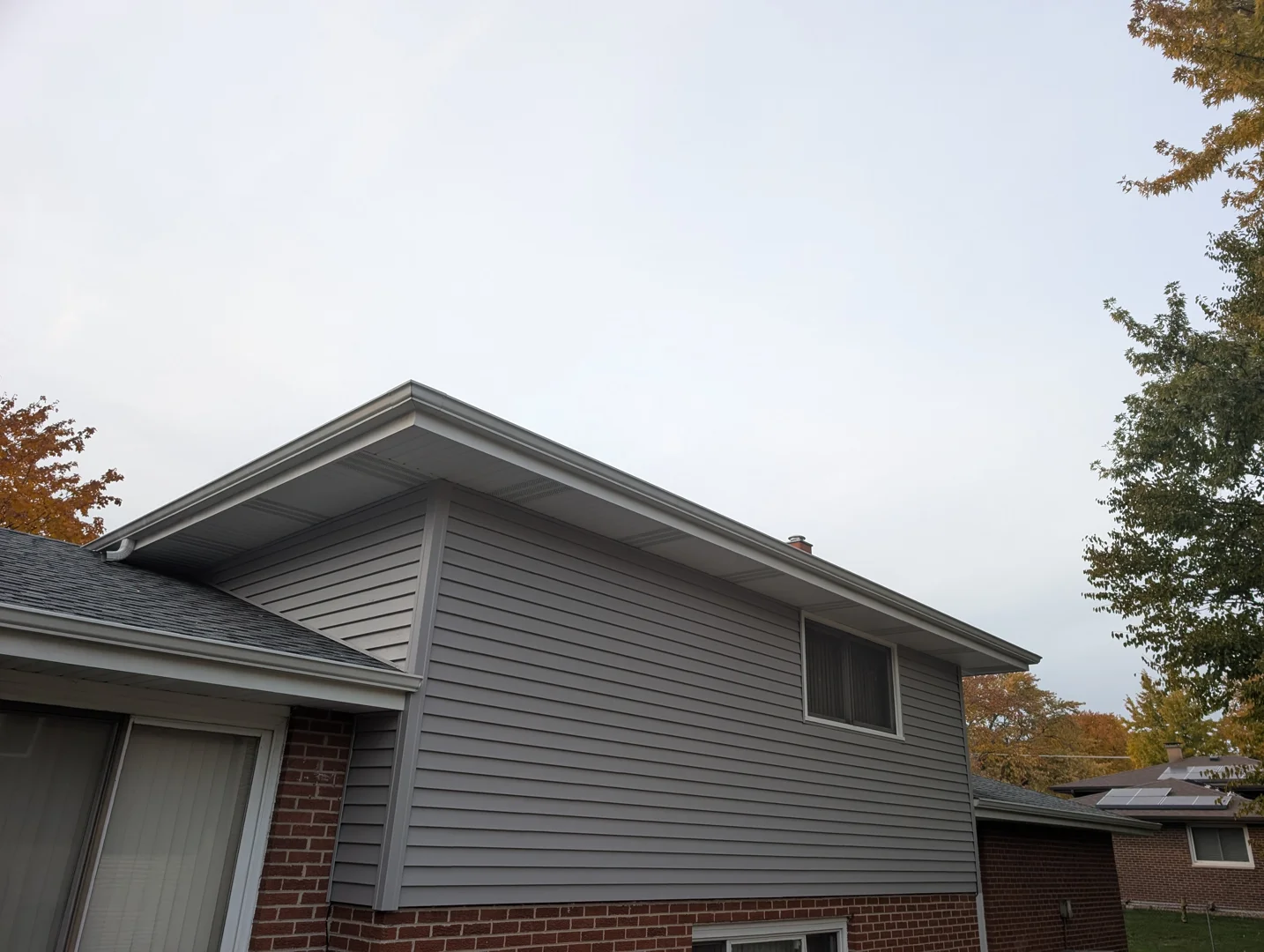
Chicago’s six-month heating season means that energy efficiency improvements from exterior home improvements reduce heating costs continuously from November through April — not just during the coldest weeks, but every single day of that period. That continuous benefit is what makes exterior improvements in Chicago a more compelling energy efficiency investment than in moderate climates where the payback period is longer.
Window replacement
The thermal performance gap between an original window from the 1970s or a failed double-pane from the 1990s and a correctly specified new window is larger than most homeowners expect. An original single-pane window has a U-factor of approximately 1.0 — essentially no resistance to heat transfer. A failed double-pane unit whose seal has broken is performing at 0.45 to 0.50 or worse. A new double-pane window with Low-E coating and argon fill installed at U-factor 0.25 loses heat at roughly one-quarter the rate of the single-pane unit and half the rate of the failed double-pane.
Across 10 to 15 windows on a standard Chicago home, that performance improvement accumulates into a measurable reduction in heating load every day of the heating season. Rooms that were consistently cold near exterior walls stabilize. Drafts near window frames diminish. The heating system runs less.
Siding replacement
Failing siding creates air infiltration pathways throughout the exterior envelope — gaps at cracked panels, failed caulking at window and door perimeters, sections where the siding has lifted from the wall. In Chicago’s climate, those pathways impose heating cost every hour of every heating day. New siding eliminates those specific pathways: intact panels, correctly sealed perimeter trim, repaired or replaced moisture barrier.
For older Chicago homes in Avondale, Rogers Park, and the older Northwest Side with minimal wall cavity insulation, upgrading to insulated vinyl siding with EPS foam backing adds a layer of continuous R-value to the wall assembly — the only siding-level intervention that improves wall insulation without opening the wall cavity.
Door replacement
An exterior door’s thermal performance is determined by three components: the door panel, the perimeter weatherstripping seal, and the threshold seal. Original hollow-core doors in worn frames typically fail on all three simultaneously — the panel has no insulating value, the weatherstripping is compressed or missing, and the threshold no longer contacts the door bottom consistently. An insulated exterior door unit with foam-core construction, compression weatherstripping, and an insulated adjustable threshold addresses all three in a single replacement.
For Chicago homes where the back door, side entry, or garage entry has been overlooked while the front door received attention, those secondary entries are often the largest remaining air infiltration source on the exterior after primary improvements have been made. We assess all exterior doors during the on-site estimate — not just the front.
Exterior home improvements affect property value in Chicago’s residential market through two channels that operate simultaneously. Understanding both helps homeowners evaluate the investment accurately rather than relying on a single metric.
The appraisal channel
Residential appraisers assess exterior condition as a component of overall property condition, which directly affects the appraised value relative to comparable sales. A home with failing windows, deteriorating siding, and worn exterior doors receives a below-average condition rating. That rating reduces the home’s appraised value relative to comparable properties in better condition — by an amount that depends on the local comparable sale data but consistently moves in the same direction.
New windows, siding, and doors improve the exterior condition rating. In Chicago’s market, where the comparable sale set for most mid-century homes includes properties that have been updated, the gap between an updated exterior and an original failing one is visible in the appraisal data. Improvements that address condition rating move the home toward the upper end of that comparable range rather than the lower end.
The buyer perception channel
The buyer perception channel operates before the appraisal — at the moment a prospective buyer first sees the home, whether in a listing photograph or driving by. Curb appeal is not a soft concept in Chicago’s residential market. It is a documented driver of buyer behavior that affects showings, offer amounts, and inspection-driven negotiations.
A home with a failing exterior generates buyer risk perception — the assumption that exterior neglect reflects interior and mechanical neglect. That perception reduces the pool of interested buyers, reduces submitted offers, and gives buyers leverage in post-inspection negotiations that they use to negotiate price concessions for conditions that the inspection finds. None of that leverage exists if the exterior presents well.
New windows, siding, and doors remove those negative signals from the home’s market presentation. The home presents as maintained, protected, and lower-risk. More buyers show interest. Offers come in stronger. Buyers have less leverage at inspection because the most visible deficiencies have been addressed.
In Glenview, Des Plaines, and the northwest suburbs where comparable properties with updated exteriors are common in recent sale data, the financial case for exterior improvement before a sale is straightforward — the comparable sale differential between updated and original exteriors in those neighborhoods is visible and consistent.
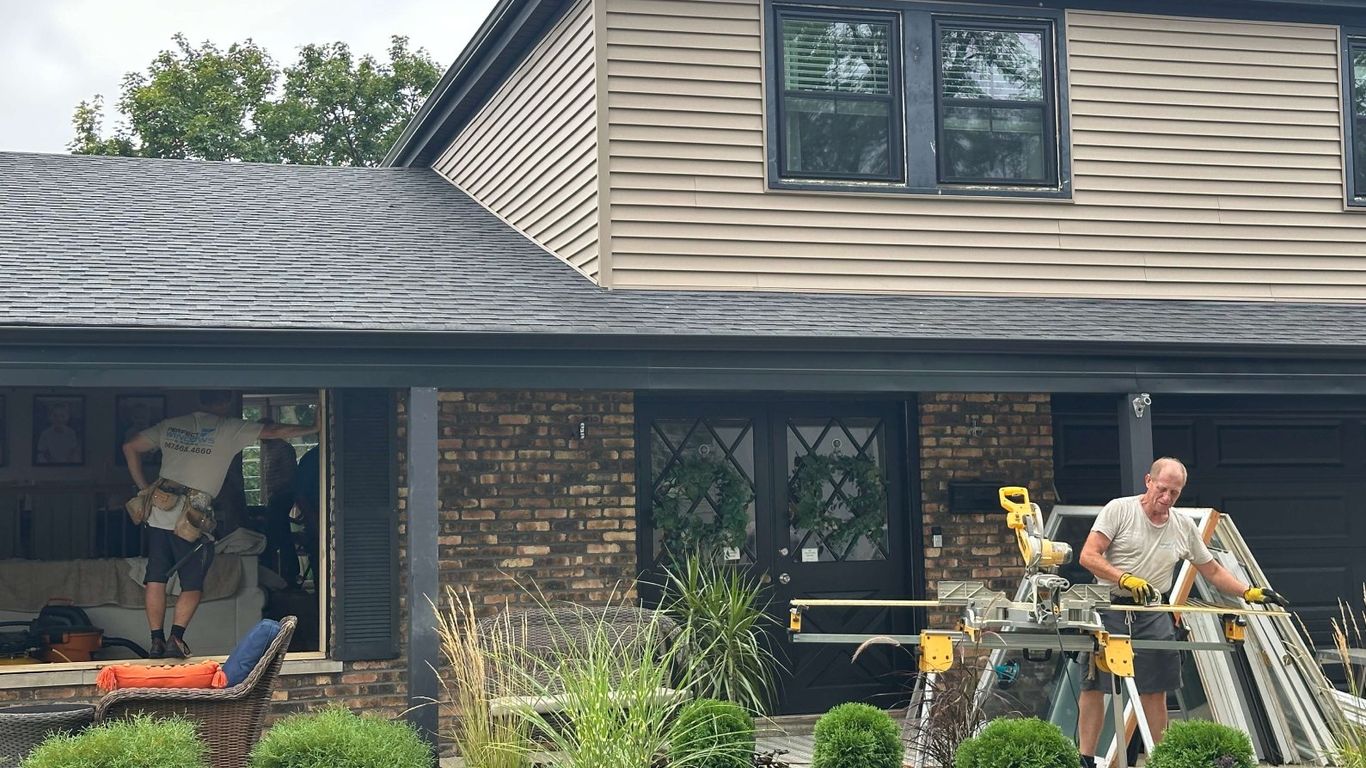
Older Chicago homes aren’t a problem to work around — they’re a significant share of the homes we work on, and we’ve been doing it long enough to know what the specific challenges are and how to address them correctly.
Non-standard opening dimensions
Homes built before the 1970s — the Chicago bungalow, the vintage two-flat, the pre-war courtyard building — were constructed with opening dimensions that predate modern standard sizing conventions. Windows in those homes frequently do not match any stock dimension. Forcing a stock window into a non-standard opening requires modification to the rough opening, the surrounding trim, or both — and both modifications compromise the result.
We order custom windows to match non-standard opening dimensions exactly. The window fits the opening as it was built. No gap-filling, no modified trim to hide a poor fit, no structural modification to the rough opening. In Lincoln Square, Andersonville, and the vintage neighborhoods of the Northwest Side, custom sizing is the norm on older homes — not the exception.
Architectural character preservation
Older Chicago homes have architectural details that stock exterior products don’t always accommodate. Window profiles with specific sight lines and proportions. Siding profiles that match original wood lap dimensions. Door styles that are compatible with 1920s or 1930s bungalow architecture rather than contemporary construction.
We address this during the product selection conversation in the estimate — presenting window profiles, siding profiles, and door styles that are compatible with the home’s original architectural character rather than ones that work generically. For homeowners in Logan Square, Wicker Park, and Andersonville who are invested in their home’s architectural character, that conversation is one of the most important parts of the estimate process.
Historic district and preservation guidelines
Some Chicago neighborhoods — portions of Logan Square, Wicker Park, and several north shore communities including parts of Evanston — have historic preservation district designations that govern visible changes to exterior materials and appearance. Those guidelines affect window profile selection, siding material choices, and door style options in ways that homeowners sometimes discover after a project is underway.
We identify whether preservation guidelines apply during the on-site estimate and scope the product options accordingly. The recommendation you receive from us is one you can actually implement — not one that creates a permit or compliance problem after the contract is signed.
Substrate conditions in older homes
Older Chicago homes frequently have wall assembly conditions that newer construction doesn’t present — absent or degraded moisture barriers, original sheathing that has been through decades of freeze-thaw cycling, multiple layers of original siding in some cases. Those conditions affect the installation approach and sometimes the project scope.
We address them honestly during the tearoff phase — when panels are removed and the substrate is visible for the first time. If we find conditions that affect the scope, we communicate what we found and what it requires before additional work proceeds. No surprises at the invoice.
An on-site assessment is the correct starting point. We walk the full exterior — windows, siding, and doors — assess each component’s condition, and give you a prioritized improvement scope specific to your home’s actual conditions. Schedule a free estimate. The assessment answers the diagnostic question specifically rather than giving you a generic checklist that applies to any house anywhere.
Window replacement, siding replacement, and entry door replacement consistently rank highest in national cost-vs-value analyses and in Chicago-area transaction data. Window replacement delivers value through thermal performance, curb appeal, and condition rating simultaneously. Siding replacement restores weather protection and removes buyer risk perception. Entry door replacement is the highest curb appeal return per scope of work of any exterior improvement.
Yes — significantly, in Chicago’s six-month heating season. Window replacement with correct U-factor and Low-E specifications cuts heat loss through the glass. Siding replacement eliminates air infiltration pathways in failing original cladding. Insulated door replacement addresses the three heat loss pathways that failing original doors produce simultaneously. All three improvements reduce heating costs every day of the heating period from November through April.
Look for a contractor licensed and insured in Illinois with documented residential exterior experience in Chicago’s specific housing stock and climate. Check the BBB rating and read Google reviews for pattern of on-time delivery, correct installation, and post-project support. A contractor who handles windows, siding, and doors under one contract eliminates the coordination and accountability gaps that arise when separate contractors work on the same exterior — particularly at window perimeter details where the two trades meet.
Single-trade projects typically take one to five days depending on scope and home size. Combined window and siding projects typically take one to two weeks. Entry door installation takes two to four hours per door. We provide a specific timeline during the free estimate based on the actual scope confirmed at the site visit.
We serve Chicago and the full Chicagoland area — including Des Plaines, Park Ridge, Morton Grove, Niles, Glenview, Winnetka, Naperville, Evanston, Hoffman Estates, and surrounding communities. Call us to schedule a free on-site estimate at your home.
Whether you’re dealing with one failing component or the whole exterior needs updating, the right first step is a free on-site assessment. We’ll walk your home, tell you what we find, and give you a straight recommendation — what needs immediate attention, what can wait, and what the right project sequence looks like for your home and your timeline.
Call us today: (847) 668-4660
We’re local, we’ve been doing this for over 20 years, and we know Chicago homes inside and out.
2026 Perfect Windows & Siding Powered by Wizerunek w Sieci - web development & SEO | Privacy | Accessibility | Terms and Conditions
This site is protected by reCAPTCHA and the Google Privacy Policy and Terms of Service apply.