

Energy-Efficient Window Upgrades in Chicago
Perfect Windows & Siding
Let’s Work Together!
Perfect Windows & Siding
Let’s Work Together!
If your home has windows that are losing heat, letting in cold air, or just not performing the way they should in a Chicago winter — an energy-efficient window upgrade is the most direct fix available. Not more weatherstripping. Not another round of caulking. A replacement window that’s actually specified to handle what this climate produces.
Energy-efficient window upgrades in Chicago address a specific and measurable problem. Windows that were installed in the 1970s, 80s, or even the 1990s were not designed to meet today’s thermal performance standards — and in a city with a six-month heating season, temperatures that regularly drop below zero, and freeze-thaw cycling that stresses every seal and frame in the home, the gap between what those windows deliver and what modern energy-efficient windows deliver is real and continuous.
We’ve been installing energy-efficient windows throughout Chicago and the surrounding suburbs for over 20 years. We specify every window for this climate — not a generic spec applied regardless of where the home is. U-factor. Low-E coating. Argon gas fill. Frame material that doesn’t conduct cold through the edges. This page covers all of it — how to know if your windows need upgrading, what the specifications mean in practice, what Low-E glass actually does, what styles are available, and how long correctly upgraded windows last in Chicago’s conditions.
Give us a call when you’re ready. The estimate is free.
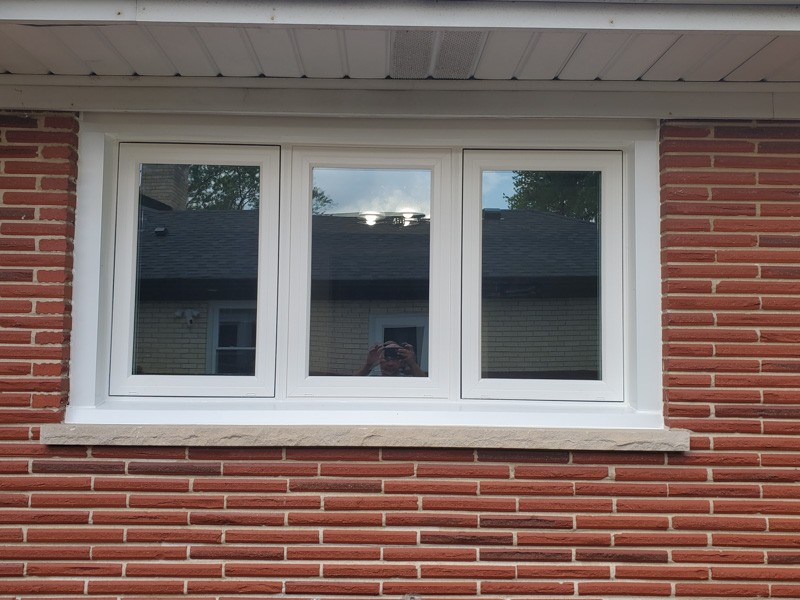
The diagnostic question — do my windows actually need upgrading, or is this a sealing issue I can fix without replacement — is worth answering correctly before any project is scheduled. The answer has real consequences for project scope and investment, and getting it wrong in either direction is a problem.
Here’s how to work through it.
Condition 1: Single-pane glass still in place
If your home has original single-pane windows — common in Chicago bungalows and two-flats built in the 1920s, 30s, and 40s — there is no sealing fix, no weatherstripping upgrade, and no perimeter caulking repair that addresses the fundamental thermal limitation of single-pane glass. A single pane of glass has a U-factor of approximately 1.0. It provides essentially no resistance to heat transfer. In a Chicago winter, the interior glass surface approaches the temperature of the outside air. It radiates cold into the room. It costs money every hour of every heating day until it’s replaced.
Single-pane glass is a specification failure, not a maintenance failure. The correct response is replacement, not service.
Condition 2: Fogged or condensation-filled glass between the panes
Visible fogging or condensation between the panes of an existing double-pane window is the most reliable indicator of a failed insulated glass unit. The hermetic seal has failed. The insulating gas fill — argon, in most units — has escaped and been replaced by humid air. The moisture in that air produces the visible fogging. The window’s insulating value has dropped from its rated U-factor to approximately single-pane performance.
A fogged double-pane window is not a dirty window. Cleaning the exterior doesn’t help — the moisture is inside the sealed unit. Replacement is the correct response.
Condition 3: Persistent drafts after weatherstripping and caulking repair
If you’ve replaced weatherstripping, recaulked window perimeters, and still have drafts near specific windows — the draft source is likely the window unit itself, not the sealing around it. A window frame that has been through 30 or 40 Chicago freeze-thaw cycles may no longer sit square, may have developed gaps in the frame joints, or may have lost the dimensional stability that allows weatherstripping to contact the sash consistently across all four edges. At that point, the frame is the failure — and service isn’t going to restore it.
Condition 4: Cold spots near windows that persist through the heating season
A cold spot near a window that is present regardless of thermostat setting and doesn’t respond to weatherstripping repair is almost always a glass specification issue. The interior glass surface of an underperforming window is cold. That cold surface radiates into the room, creates convective air circulation as warm room air contacts it and falls, and makes the space near the window feel colder than the measured air temperature. Double-pane Low-E glass at U-factor 0.25 has a significantly warmer interior surface than single-pane or failed double-pane glass — the cold spot diminishes after the upgrade because the surface that was creating it is no longer cold.
Condition 5: Heating bills that seem high for the home’s size
This is the least specific indicator but the most motivating one for many Chicago homeowners. If your heating bills have been climbing without an obvious explanation, and your windows are original or from the 1990s, underperforming windows are a reasonable suspect. An on-site assessment can confirm whether the windows are the primary source of thermal loss or whether the issue is elsewhere in the building envelope.
In Jefferson Park, Norwood Park, and the older northwest suburbs where original 1990s double-pane installations are now reaching the end of their service life, all five conditions are commonly found together in the same home during a single estimate visit. The convergence of multiple indicators across several windows is itself a diagnostic — it suggests a system that has reached end of life, not an isolated failure point.
Energy efficiency in a window is not a single specification — it’s the combined result of glass performance, frame thermal conductivity, and installation quality working together. Understanding what each component contributes helps homeowners evaluate product options accurately and avoid the most common specification mistake in Chicago’s market: buying a window that carries an energy-efficient label but performs significantly worse than a correctly specified unit because one or more of the key specifications was omitted.
U-factor: the primary performance metric for Chicago
U-factor measures the rate at which the complete window assembly — glass, gas fill, spacer, and frame — loses heat to the outside. The scale runs from 0 to 1. Lower values indicate slower heat loss and better thermal performance.
The correct U-factor threshold for Chicago residential window upgrades is 0.30. A window at U-factor 0.30 or lower meets the thermal performance requirement for this climate. A window at U-factor 0.25 — achievable with double-pane Low-E argon-fill glass in a vinyl or fiberglass frame — is the specification we recommend for most Chicago homes. It loses heat at roughly half the rate of a window at U-factor 0.50, and at one-quarter the rate of single-pane glass at U-factor 1.0.
A window marketed as energy-efficient with a U-factor of 0.42 is technically an improvement over single-pane glass. In Chicago’s heating-dominated climate, it is significantly underspecified relative to what a correctly upgraded window delivers. The label doesn’t tell you enough — the number does.
Solar Heat Gain Coefficient: the secondary metric
SHGC measures how much solar heat the window allows into the interior — lower SHGC means less solar heat gain. In Chicago’s climate, SHGC is a secondary consideration relative to U-factor — the heating season is long and the cooling season is shorter, so prioritizing heat retention over solar heat rejection is usually the correct trade-off. That said, SHGC is relevant for specific orientations.
South- and west-facing windows in Chicago’s residential stock can overheat in summer — rooms that face south with large window areas collect significant solar heat gain on summer afternoons. For those exposures, specifying lower SHGC glass reduces cooling load without affecting heating performance, because the same Low-E coating that reduces SHGC also improves U-factor.
For north-facing windows in Rogers Park, Avondale, and the Northwest Side where solar gain is minimal in any season, SHGC is essentially irrelevant and U-factor is the only metric that matters.
Frame material: the thermal bridge you don’t see
The frame surrounds the glass and connects it to the wall. It’s also a heat transfer pathway. The frame material’s thermal conductivity determines how much heat escapes through the frame edges — around the entire perimeter of the glass area, in every window in the home.
Aluminum frames conduct heat at a rate that creates a significant thermal bridge regardless of the glass unit’s performance. In a Chicago winter, an aluminum-framed window conducts cold through the frame itself — producing condensation at the frame edges, cold spots at the window perimeter, and measurable heat loss that adds to the glass unit’s losses. A correctly specified double-pane Low-E IGU in an aluminum frame will have a whole-unit U-factor that is significantly worse than the glass specification alone suggests.
Vinyl frames have low thermal conductivity and do not create this thermal bridge. Fiberglass frames perform similarly on thermal conductivity and have greater dimensional stability across Chicago’s temperature extremes. For Chicago energy-efficient window upgrades, vinyl or fiberglass frames are the correct default. Aluminum is not appropriate for most Chicago residential applications.
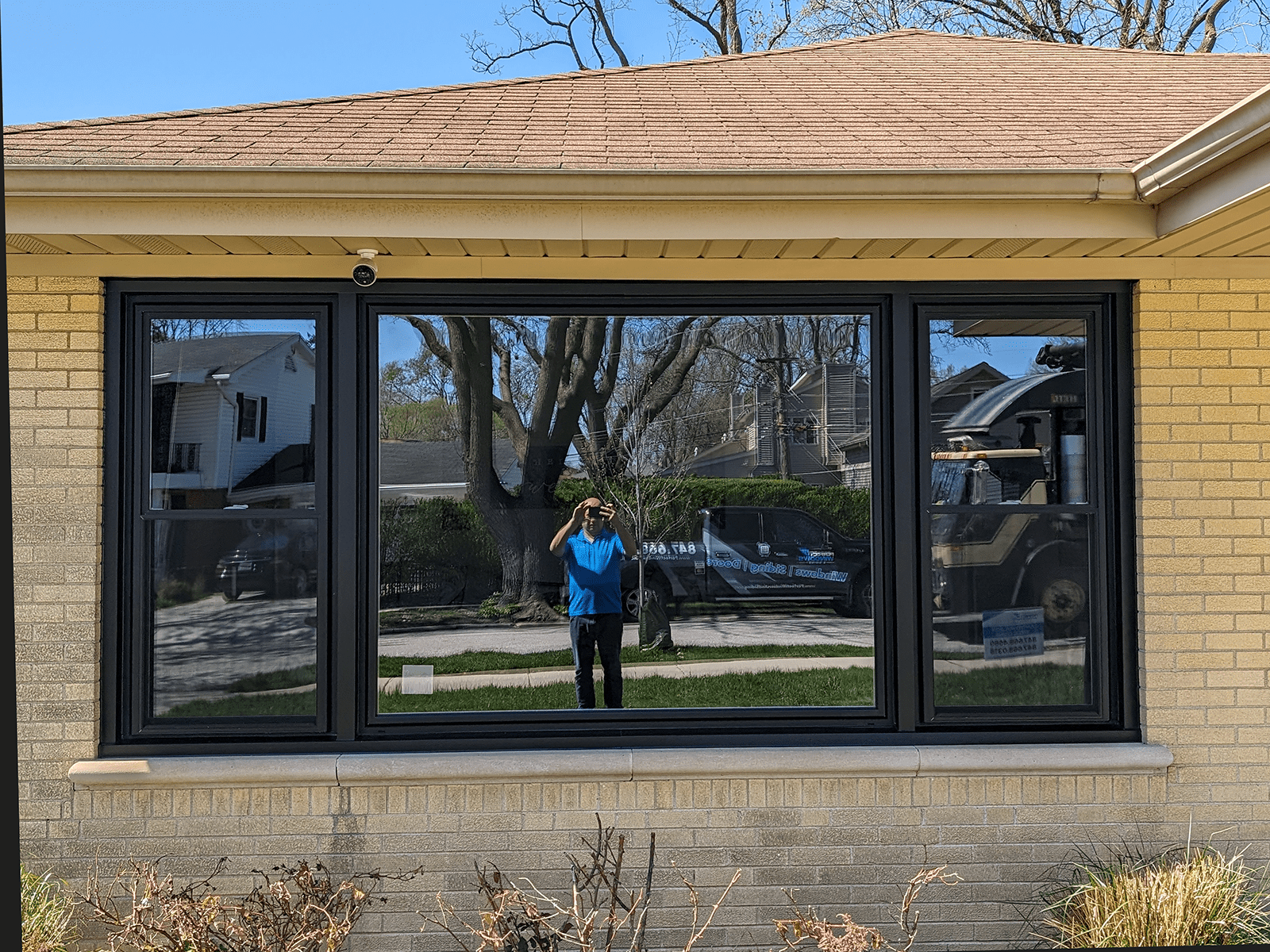
Low-E glass comes up in almost every energy-efficient window upgrade conversation in Chicago — and deservedly so, because it’s one of the most consequential single specifications on any window label. Here’s what it actually does, without the marketing language.
The mechanism
Low-E stands for low-emissivity. Emissivity is a material’s tendency to radiate thermal energy. A microscopically thin metallic coating applied to one surface of the glass reduces that surface’s emissivity — it reflects infrared radiation rather than allowing it to pass through.
In practical terms: heat radiates from warm surfaces toward cold surfaces. In a Chicago winter, the warm surfaces are inside the home and the cold surfaces are outside. Without Low-E, infrared radiation from interior surfaces — walls, furniture, people — passes through the glass and is lost to the outside. With Low-E, that radiation is reflected back into the room. The window becomes a reflective barrier for thermal radiation rather than a transparent one.
In summer, the direction reverses. Solar radiation carrying thermal energy tries to enter the room through south- and west-facing windows. Low-E coating reflects a portion of that radiation before it enters — reducing the cooling load in rooms that would otherwise overheat in the afternoon sun.
Why it’s standard, not optional, in Chicago
A double-pane window without Low-E coating in Chicago’s climate is leaving significant thermal performance unrealized. The argon gas fill slows conductive heat transfer through the gas layer. Low-E addresses the radiant heat transfer component — a separate and meaningful pathway. Without Low-E, the window performs better than single-pane but worse than it could with the coating.
The performance difference between a double-pane unit with Low-E and one without is not marginal in Chicago’s heating season. It shows up on utility bills. It shows up in room temperature stability. It shows up in how warm the interior glass surface feels when you stand next to it in January.
We specify Low-E on every energy-efficient window upgrade we install in Chicago. It is a standard component of the correct specification for this climate, not an upgrade tier that requires a separate decision.
The UV blocking benefit
Low-E coating blocks a significant percentage of UV radiation — the wavelength that causes fading in interior furnishings, flooring, and artwork. This is a secondary benefit of the coating, not a performance driver, but it’s worth knowing about for Chicago homeowners with south or west exposure and significant interior investment in fabrics, hardwood floors, or artwork. The fading protection is present every day the sun shines through those windows, across the full service life of the installation.
For homeowners in Evanston, Winnetka, and the north shore suburbs with large window areas on south and west elevations, the UV blocking benefit compounds across decades of occupancy in a way that adds real value to an upgrade that was already justified on thermal performance grounds alone.
Energy-efficient specifications — Low-E coating, argon gas fill, correct U-factor, vinyl or fiberglass frames — are available across the full range of residential window styles. The upgrade doesn’t constrain you to a specific look or configuration. It constrains you to a performance standard, and that standard is achievable in whatever style fits your home.
Double-hung
The most common window style in Chicago’s residential stock — both sashes operable, both tilt inward for cleaning, suitable for most residential applications. Correctly specified double-hung windows with Low-E argon fill at U-factor 0.25 perform well for Chicago’s climate. The meeting rail between the upper and lower sash is the primary air infiltration point in double-hung configurations; correctly maintained weatherstripping at that rail controls infiltration to an acceptable level. For most Chicago homeowners upgrading from original windows, double-hung is the natural replacement choice.
Casement
Casement windows hinge at the side and open outward with a crank mechanism. When the window is closed and locked, the sash is pulled tight against the frame seal — compressing the weatherstripping and producing an air barrier that is tighter than any double-hung configuration can achieve. The meeting rail air infiltration issue that double-hung windows manage through weatherstripping maintenance doesn’t exist in a casement — there is no meeting rail.
For homeowners in Chicago who are prioritizing maximum thermal performance in an operable window, casement is the style that delivers it. The trade-off is operational — you crank to open rather than sliding a sash — and the visual profile change from double-hung, which in some Chicago neighborhoods is an aesthetic consideration worth thinking through before specifying.
Fixed picture windows
Fixed windows — no operable sash — are the most energy-efficient residential window configuration available. No sash-to-frame gap, no meeting rail, no mechanical components that wear over time. The glass is set in the frame and stays there. Thermal performance is limited only by the glass specification and frame material.
For rooms where ventilation is not required — a dining room with a street-facing view, a stairwell landing, an accent window above a front door — fixed picture windows in energy-efficient configurations deliver maximum thermal performance at the same specification cost as operable units.
Custom configurations
Arched tops, angled frames, non-standard dimensions, and specialty shapes are all available in energy-efficient specifications. Chicago’s older housing stock — the pre-war construction of Lincoln Square, Andersonville, and Pilsen — has a high concentration of opening dimensions that don’t match modern standard sizing. Custom orders address those openings correctly. The energy-efficient glass specifications, Low-E coating, argon fill, and frame material options are all available in custom dimensions.
Noise reduction — combined with energy efficiency
Standard double-pane Low-E glass provides meaningful noise reduction relative to single-pane — the gas-filled gap between the panes interrupts sound transmission. For most Chicago homeowners, the noise reduction from standard double-pane installation is noticeable and welcome.
For homeowners near the L — the Blue Line through Logan Square and Wicker Park, the Red Line through Rogers Park, the Brown Line through Lincoln Square — or near expressways and major arterials, acoustic laminated glass is available as an upgrade alongside Low-E and argon fill. Acoustic glass uses a laminated interlayer that specifically targets sound transmission reduction rather than thermal performance, and it can be combined with Low-E and argon fill in the same unit. The result is a window that addresses energy efficiency and noise reduction simultaneously — which is exactly what many Chicago homeowners near transit corridors need.
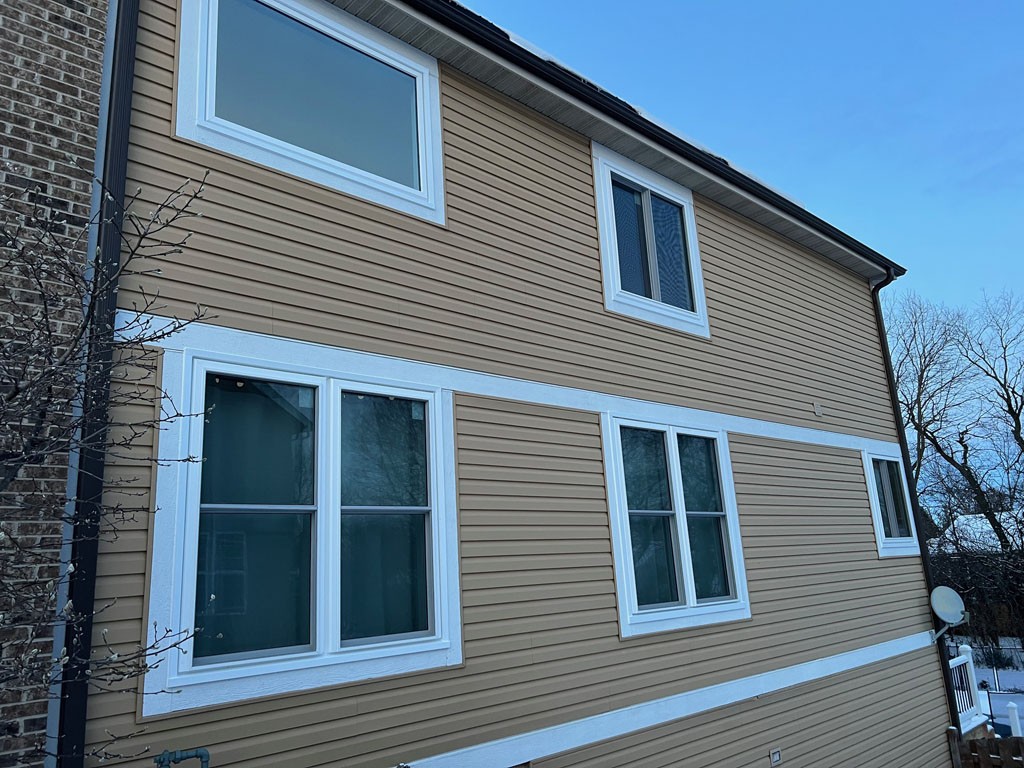
Correctly installed energy-efficient windows in Chicago have a service life of 20 to 30 years for the insulated glass unit. The glass itself doesn’t fail — the IGU seal does. And the timing of that failure is determined more by installation quality and product specification than by anything else.
What determines service life
The IGU seal is subjected to mechanical stress every time the window assembly expands and contracts with temperature changes. In Chicago’s climate, that cycling happens hundreds of times per year across a temperature range that can exceed 100 degrees between winter and summer extremes. Each cycle puts cumulative stress on the seal perimeter. Over time, that cumulative stress eventually compromises the seal.
Installation quality is the most consequential variable in that process. A unit installed with correct shimming, proper perimeter air sealing, and adequate sash support experiences only the mechanical stress that normal temperature cycling produces. A unit installed without those details experiences additional stress from improper support, differential movement at the frame, and perimeter air movement that accelerates the seal degradation process.
Spacer system quality matters too. The spacer is the component that maintains the gap between the two panes and seals the gas fill inside. Higher-quality spacer systems use materials with lower thermal conductivity — reducing the thermal stress at the seal perimeter — and adhesive bonds that maintain integrity across more temperature cycles. Budget spacer systems use materials that conduct cold readily and adhesives that degrade faster under Chicago’s cycling conditions.
South and west exposures age faster
South-facing windows in Chicago experience more daily temperature cycling than north-facing windows on the same home — the glass surface heats in afternoon sun and cools overnight, completing a full thermal cycle every day in addition to the seasonal cycle. West-facing windows experience similar afternoon heating. Units on those exposures reach the upper end of their annual cycle count faster than north-facing units, and seal failure tends to appear earliest on south and west elevations in any Chicago installation.
For homeowners in Glenview, Park Ridge, and Des Plaines planning whole-home window upgrades, this is worth knowing when planning a replacement schedule. If budget requires phasing, north-facing units can often wait a phase longer than south and west-facing units of the same age.
When a seal fails: your options
When an IGU seal fails — indicated by fogging between the panes — two paths are available.
Glass-only IGU replacement is appropriate when the frame is structurally sound, dimensionally stable, and has meaningful remaining service life. A new insulated glass unit is ordered to the sash opening dimensions, the failed unit is removed from the sash, and the new unit is installed and resealed. The window’s thermal performance is restored at a lower scope than full unit replacement.
Full unit replacement is appropriate when the frame is warped, out of square, has moisture damage, or is itself at or near end of life. Installing a new IGU into a frame that will need replacement in two to three years is a short-term fix at a scope that may not justify the investment if full replacement is the correct long-term answer.
We assess the frame condition during the on-site estimate and give you a direct recommendation on which path is correct — not the one that produces the larger project, but the one that actually serves your home correctly.
Five indicators: single-pane glass in place, fogged glass between panes, persistent cold spots after weatherstripping replacement, persistent drafts after caulking repair, and heating bills that seem high for the home’s size. Any one of those conditions warrants an on-site assessment. Multiple conditions together almost always indicate that the windows themselves are the problem — not the sealing around them. Our free estimate confirms the finding and defines the correct scope.
U-factor 0.30 or lower is the correct performance threshold for Chicago residential upgrades. We specify U-factor 0.25 for most Chicago homes — achievable with double-pane Low-E argon-fill glass in a vinyl or fiberglass frame. A window above U-factor 0.35 is underspecified for Chicago’s heating-dominated climate. The U-factor number on the label tells you more than the marketing language around it.
Low-E coating reflects infrared radiation — keeping heat inside the home in winter and blocking solar heat gain in summer. In Chicago’s heating-dominated climate, the winter heat retention benefit is the primary driver. Low-E is a standard specification for Chicago energy-efficient upgrades — not an optional add-on. A double-pane window without Low-E in Chicago leaves significant thermal performance unrealized, and we spec it on every installation.
Yes — double-pane glass provides meaningful noise reduction relative to single-pane. For homeowners near the L, expressways, or major arterials, acoustic laminated glass is available alongside Low-E and argon fill for combined energy performance and noise reduction in the same unit. The noise reduction from standard double-pane Low-E installation is noticeable on its own — the acoustic glass option is for homeowners with significant noise exposure who want to address both issues at once.
A single window takes one to two hours. A whole-home upgrade with 10 to 15 windows typically takes one to two days. We provide a specific timeline during the free estimate based on the number of openings, window styles, and any substrate repair identified during the on-site assessment.
We serve Chicago and the full Chicagoland area — including Des Plaines, Park Ridge, Morton Grove, Niles, Glenview, Winnetka, Naperville, Evanston, Hoffman Estates, and surrounding communities. Call us to schedule a free on-site estimate at your home.
If your windows are costing you in heating bills, cold rooms, or noise you shouldn’t be living with — the fix starts with a free on-site estimate. We’ll assess every window, confirm which ones are underperforming and why, and give you a specific recommendation before anything gets ordered.
Call us today: (847) 668-4660
We’re local, we know Chicago homes, and we’ll give you straight answers from the first visit.
2026 Perfect Windows & Siding Powered by Wizerunek w Sieci - web development & SEO | Privacy | Accessibility | Terms and Conditions
This site is protected by reCAPTCHA and the Google Privacy Policy and Terms of Service apply.